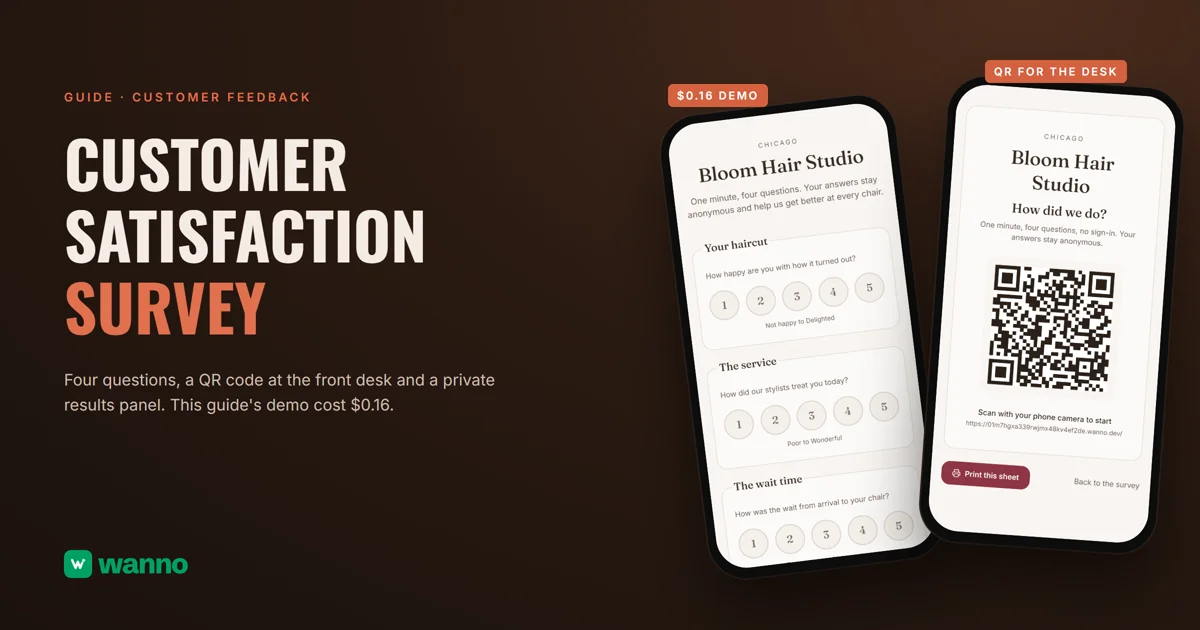
A customer satisfaction survey only works if people finish it, and people finish what is short. This guide gives you a template with 10 questions ready to copy, explains CSAT, NPS and CES with worked examples, and covers when and where to ask, how to close the loop with anyone who scores you low, and what to watch with personal data. The example, for Bloom Hair Studio, an invented hair salon in Chicago, was built in wanno, a platform that builds websites and apps with AI from your phone, in 2 minutes 32 seconds and cost $0.16.
In short: a customer satisfaction survey is a short questionnaire, about 10 questions, that people answer right after a visit. CSAT is the percentage of answers of 4 and 5 on a 1 to 5 scale; NPS is the percentage of promoters (9 and 10) minus the percentage of detractors (0 to 6); CES is the average of how easy the customer found it. To start, one satisfaction question and one 0 to 10 recommendation question, asked with a QR code, are enough.
Updated November 17, 2026.
The summary: where to ask
| Place | Best moment | Example |
|---|---|---|
| QR at the front desk | at checkout | hair salon, barbershop, shop |
| QR on the table | while waiting for the check | restaurant, coffee shop |
| QR in the room | at breakfast or on checkout day | inn, rental |
| Text message or email | the same day, a few hours later | deliveries, bookings |
01. What is a customer satisfaction survey and what is it for?
A customer satisfaction survey is a short questionnaire that asks someone who just bought from or visited your business how it went. It turns opinions into numbers you can compare, shows what is going wrong before the customer leaves for good, and tells you what to fix first.
For a small business it does three jobs:
- Shows which part of the visit works (the haircut, the service, the wait) and which does not.
- Lets you compare week over week to see whether a change helped.
- Helps you find the person who left unhappy while you can still write to them.
02. Why most people skip a customer satisfaction survey
The common mistake is asking too much: twenty questions, a sign-up with an email and a link that arrives three days later. Every extra step costs answers, and the ones that remain come from people who are delighted or furious.
If you use a generic form, check its limits before printing a QR code. According to its pricing page, Typeform's free plan includes 10 responses per month across all your forms. And according to its pricing page, SurveyMonkey's free plan allows up to 10 questions per survey. What you need is your own survey, with your name and your questions, that opens without an account and saves everything where you can see it.
03. What is CSAT? CSAT, NPS and CES explained with examples
The three most-used satisfaction metrics are CSAT (satisfaction with one thing), NPS (likelihood to recommend) and CES (customer effort). Each answers a different question, and with round numbers you can calculate them by hand.
CSAT: how satisfied someone was with one specific thing. According to Qualtrics, CSAT, or customer satisfaction score, indicates how satisfied customers are with a company's products or services, is expressed as a percentage, and is calculated from the responses of 4 (satisfied) and 5 (very satisfied) on a 1 to 5 scale.
CSAT = (ratings of 4 and 5 ÷ total ratings) × 100
Example (made-up numbers): of 100 haircut ratings, 72 are a 4 or 5. CSAT = 72 ÷ 100 × 100 = 72%.
NPS: how likely someone is to recommend you. The official Net Promoter System site puts it this way: ask how likely someone is to recommend you on a zero-to-ten scale, and your NPS is the percentage of promoters (those who scored 9 or 10) minus the percentage of detractors (those who scored 0 to 6). Those who answer 7 or 8 are passives: they neither add nor subtract.
NPS = % promoters (9 and 10) minus % detractors (0 to 6)
Example (made-up numbers): of 100 answers, 55 are a 9 or 10, 30 are a 7 or 8 and 15 are 0 to 6. NPS = 55% minus 15% = 40. The result runs from minus 100 to 100.
CES: how easy it was. CES (Customer Effort Score) measures how much effort it took the customer to get something done: book, pay, get help. You ask "How easy was it to...?" on a scale from 1 (very difficult) to 5 (very easy); pick one scale and stick to it. It is usually summarized as the average.
Example (made-up numbers): five clients answer 5, 4, 4, 3 and 4. CES = 20 ÷ 5 = 4.0 out of 5.
How to choose: CSAT for a visit or one service, NPS to learn whether people would recommend you, and CES when the problem looks like the process (booking, paying). To start, CSAT and NPS are enough. wanno stores the answers and shows the average of each question; the CSAT percentage and the NPS are yours to work out with these formulas.
04. Customer satisfaction survey questions: a template with 10 to copy
This is the template you would use in a salon like Bloom Hair Studio, grouped by topic. Copy it into your document or your survey and change whatever does not fit your business.
Overall satisfaction
- Overall, how satisfied were you with your visit? (1 to 5)
The product 2. How would you rate your haircut? (1 to 5) 3. Did the result match what you asked for? (yes / mostly / no)
The service 4. How would you rate the service you received? (1 to 5) 5. How easy was it to book and pay? (1, very difficult, to 5, very easy; this is the CES question)
Time 6. How would you rate the wait time? (1 to 5) 7. When did your appointment start? (on time / up to 15 minutes late / more than 15 minutes late)
Recommendation 8. How likely are you to recommend us to a friend or colleague? (0 to 10; this is the NPS question) 9. Is this your first visit? (yes / no)
Open question 10. What is the one thing we should change? (optional)
How many questions: the shorter the survey, the more answers you get. The demo survey asks what questions 2, 4, 6 and 8 ask, plus an optional comment like question 10; the other five are for when you want to dig deeper. If you want a document to print, copy the template and save it as a PDF; the digital version with a QR saves you retyping by hand.
Extra questions for your business. Swap in or add questions like these:
- Retail shop: Did you find what you were looking for? (yes / partly / no). Was the price fair for what you got? (1 to 5)
- Hair salon: Did your stylist explain how to care for your hair at home? (yes / no). Would you book with the same stylist again? (yes / maybe / no)
- Inn or rental: Was the room clean when you arrived? (1 to 5). Did the room match the photos and description? (yes / partly / no)
- Delivery orders: Did your order arrive complete and on time? (yes / no). Did it arrive in good condition? (yes / no)
- Restaurant: Was your food served at the right temperature? (yes / no). Would you come back? (yes / maybe / no)
05. How to write a customer satisfaction survey, step by step
- Decide what you want to learn: one concrete decision, for example whether the problem is the wait.
- Pick the questions from the template: few, on the same scale.
- Start general and end with the open question.
- Put it where the client already is: a printed QR code at the desk or on the table.
- Try it yourself from a phone before you print it.
- Review the results every week and act on the lowest average.
When and where. Right after the visit, while the memory is fresh. A QR code works for people on site; a text or email works for deliveries and bookings, the same day. If you already have a QR menu, the survey can sit on the same stand, and you can make the code with the free QR generator.
06. How to read the results and close the loop with low scorers
To read customer satisfaction survey results, look at the average for each question, compare week over week, group the comments by theme and get back quickly to anyone who scored you low.
Averages per question. Look at each question separately. Round-number example: haircut 4.6, service 4.4 and wait time 3.2. The problem is not the scissors, it is the wait, and you know where to act.
Trend. Compare week over week, not a single day: with few answers, one client moves the average.
Comments. Read them once a week and group them by theme: wait, price, booking. If a theme shows up three times, it is a task.
Closing the loop. It means getting back quickly to anyone who scored you low: thank them, acknowledge the problem and tell them what you changed. It usually takes just one message. To do it you need a way to reach them, for example an optional phone or email field; the demo survey does not have one and you would have to ask for it. If you add it, say what you will use it for.
wanno shows the latest comments in the panel, so you can read right away what clients are telling you.
07. Personal data in a customer satisfaction survey
The survey in this guide asks for no name or email, which is the safest setup: what you do not collect, you do not have to protect. If you decide to ask for them so you can follow up with a client, say what you will use them for.
For a US business, the FTC's guide on protecting personal information puts it plainly: "If you don't have a legitimate business need for sensitive personally identifying information, don't keep it." And: "In fact, don't even collect it." It speaks of sensitive data in general, not surveys, but the logic applies. As a rule of thumb, ask only for what you need and add one line near the comment box: "Please don't include personal details." If your business handles sensitive data, talk to a lawyer.
Put it into practice: a survey with a panel and a QR sheet in minutes
This is the exact prompt used in wanno for Bloom Hair Studio:
I want a customer satisfaction survey for my hair salon in Chicago, Bloom Hair Studio: clients rate the haircut, the service and the wait time from 1 to 5, answer from 0 to 10 how likely they are to recommend us, leave an optional comment, and there is a QR code I can print for the front desk. Plus a private panel with the average for each question, a chart of the results and the latest comments. Save the answers in the cloud so I can see them from any device. The survey must open without signing in and only the panel asks for a password. Everything visible in the app must be in English.
wanno built it on its own: 2 minutes 32 seconds, 33 steps and $0.16 in total. It ran on its test link.
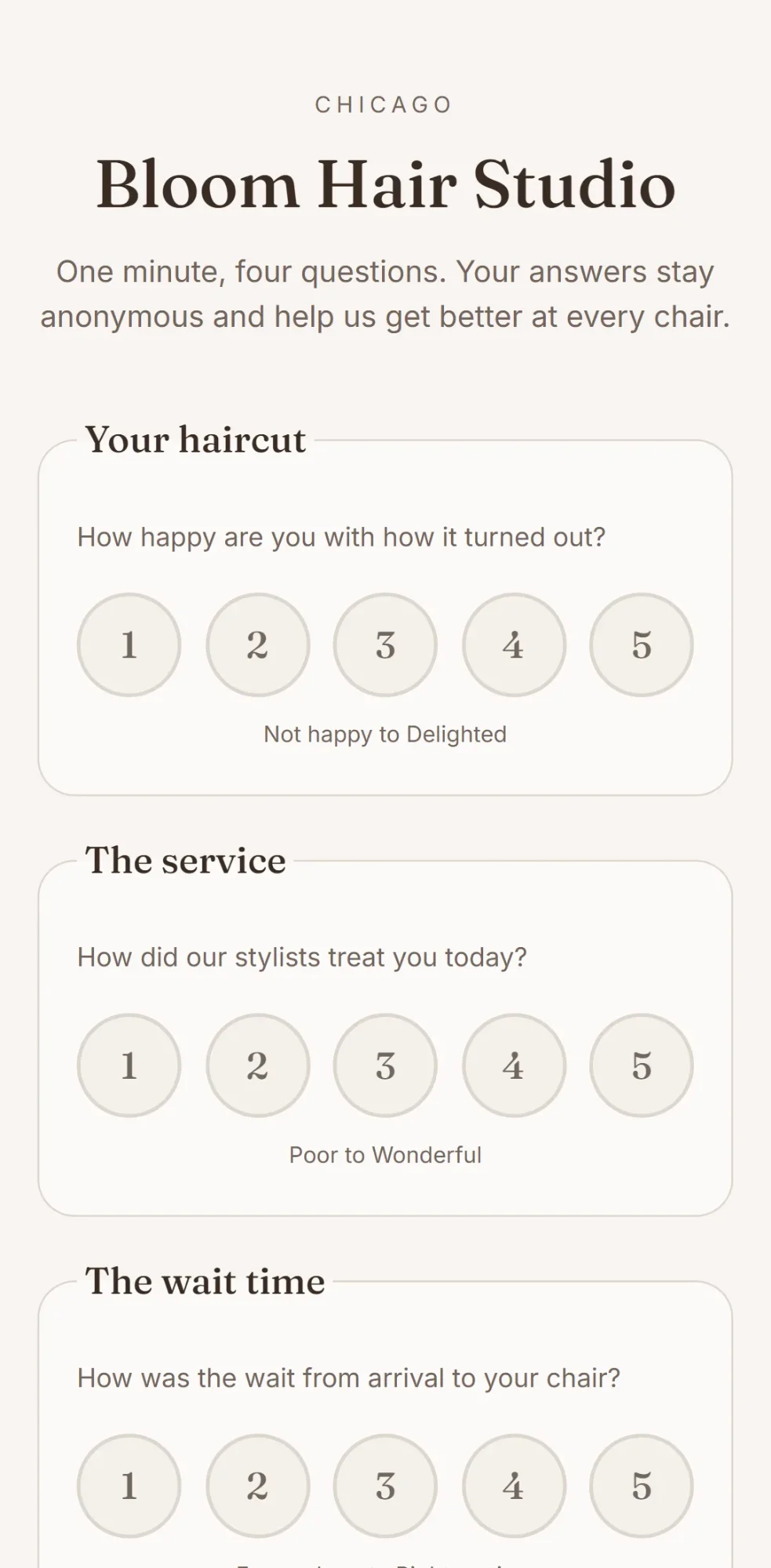
What you get is a survey that opens with no account, with the three ratings, the 0 to 10 recommendation question, the optional comment and a thank-you message after sending. Answers are saved in the cloud and visible from any device. The private panel, which you activate by choosing your password, shows the average of each question (the three out of 5 and the recommendation out of 10), a chart of how the ratings are spread and the latest comments. With a wrong password it shows no data.
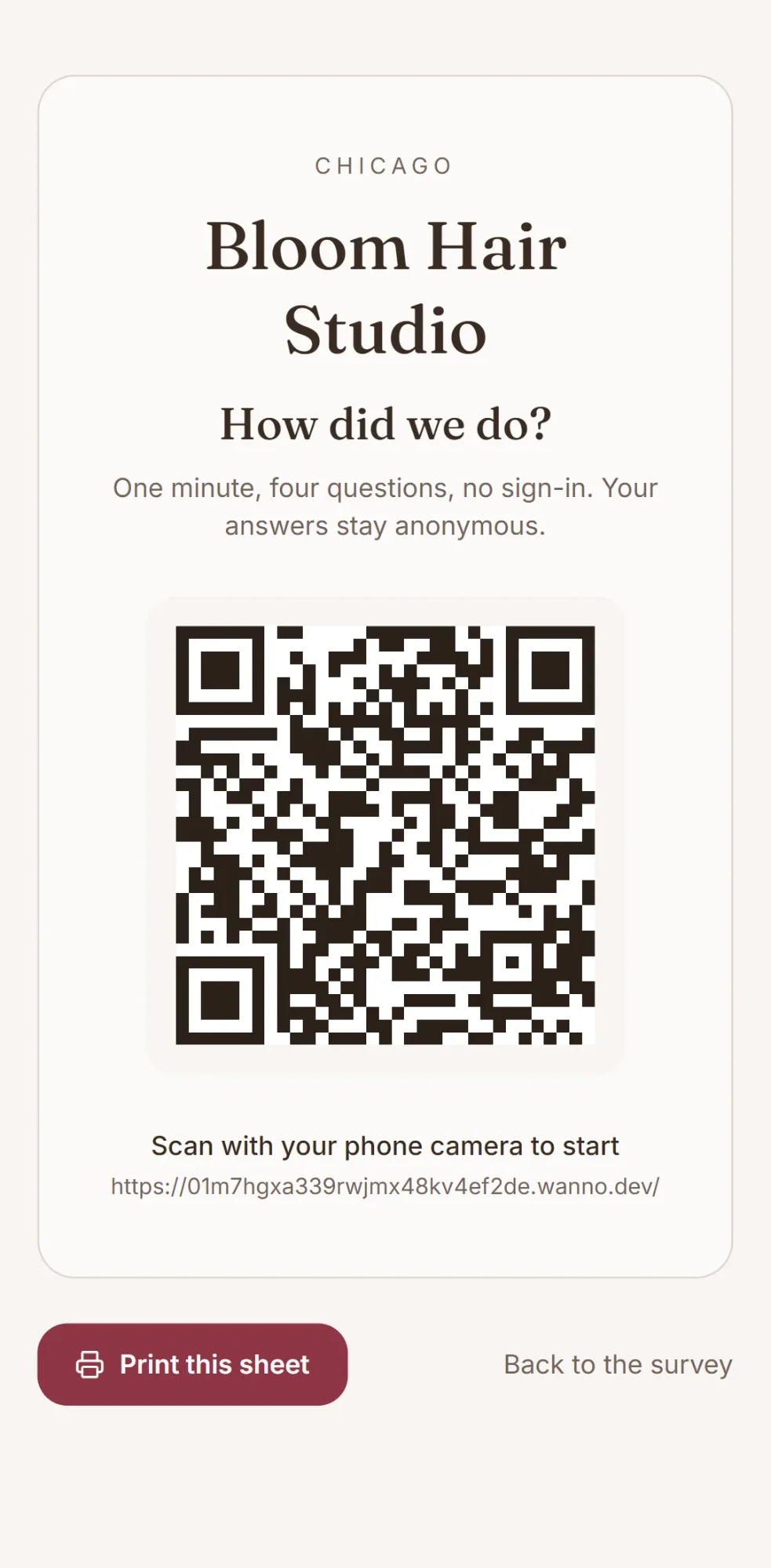
The QR sheet is ready to print for the front desk. One clarification about the panel: it shows the average of the 0 to 10 question, but it does not calculate NPS; you do that math yourself, as in the example above. The salon and data are examples. Before printing, send a test answer and check it in the panel.
The cost: $0.16 is paid once and fits within a single day's free credit. For comparison, the wanno Starter plan costs $4.99 a month with $10 in credits included, about $0.17 a day, every day (see plans).
Build your customer satisfaction survey in wanno
Describe your business and your questions in wanno and have the QR ready for the next client. If you then want to reward the ones who come back, see how to set up a loyalty program.
Frequently asked questions
What is a customer satisfaction survey? It is a short questionnaire that measures how satisfied someone was with your product, your service or your visit. It is answered right after the visit and gives you numbers you can compare week to week. With wanno you build your own, with your name and your questions.
What are 5 good survey questions? Start with a rating for the thing you sell, one for the service, one for the wait, the 0 to 10 recommendation question and an optional comment. That is what the demo survey asks: four quick questions plus an optional comment; the template above adds five more. In wanno you can ask for the ones that fit your business.
What is CSAT, and how do you calculate NPS? CSAT is the share of answers of 4 and 5 on a 1 to 5 scale. NPS is the percentage of promoters (9 or 10) minus the percentage of detractors (0 to 6) on the 0 to 10 question, so it runs from minus 100 to 100. Both are worked out by counting answers, not from the average, and wanno saves every answer in your own survey.
How do you write a customer satisfaction survey? Decide what you want to learn, pick a few questions on the same scale, ask right after the visit with a QR code, test it from your phone and review results every week. In wanno the QR sheet and the panel come out of the same build.
Can I do a customer satisfaction survey for free?
Yes. wanno's free plan gives a daily credit of $0.30 with a monthly cap of $1.50, and the survey in this guide cost $0.16. On the free plan the page lives on a wanno.dev subdomain with the "Built with wanno" badge. You pay if you want to remove the badge, use your own domain or ask for more changes than the credit covers.
Do I have to collect personal data? No. Ratings and an optional comment are enough, and the wanno survey in this guide asks for no name or email.
Read next: How to validate a business idea before you invest