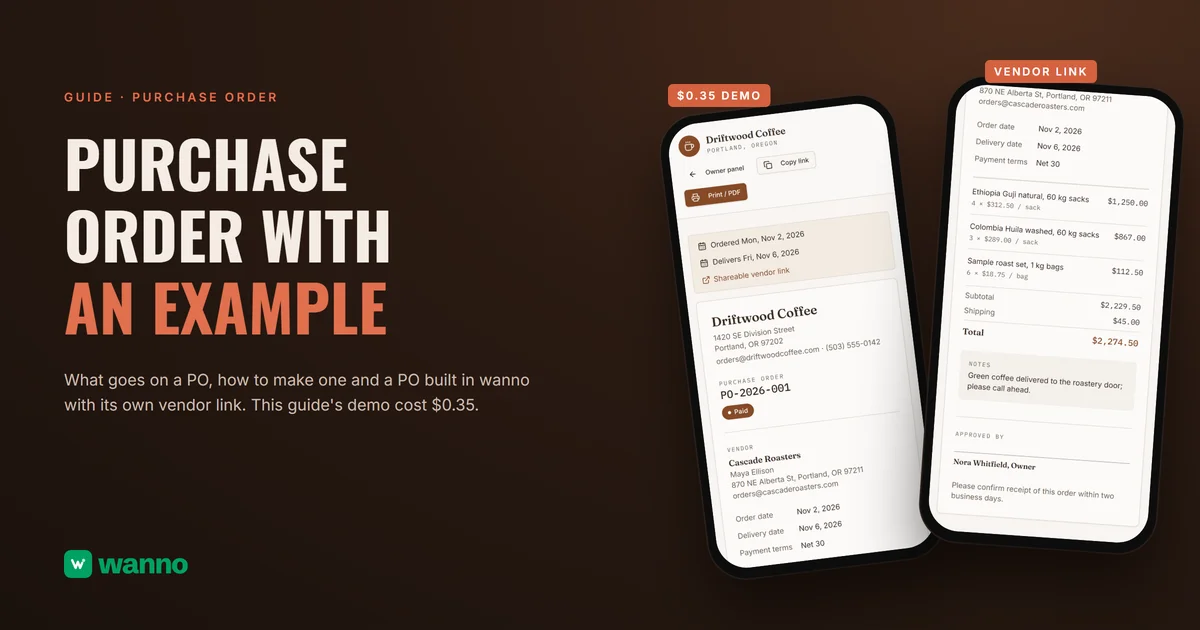
A purchase order is the document a buyer sends to a vendor to order goods or services, with quantities, prices and a delivery date. This guide explains what a purchase order is, which fields it needs, how to fill one in with a complete example you can copy, and how it differs from a quote, an invoice and a packing slip. The example PO, for an invented coffee shop in Portland, was built in wanno, a platform that builds websites and apps with AI from your phone, in 3 minutes 10 seconds and cost $0.35 with adjustments included.
In short: a purchase order (PO) is a document issued by the buyer that states what is being ordered, from whom, at what price, when it should arrive and how it will be paid. It carries a PO number, both parties' details, line items with quantity and unit price, subtotal, shipping or tax, total, payment terms (such as Net 30) and who approved it. It does not replace the vendor's invoice.
Updated November 18, 2026.
At a glance: the documents in a purchase
| Document | Issued by | What it does |
|---|---|---|
| Quote or estimate | the vendor | states what it would cost |
| Purchase order | the buyer | places and authorizes the order |
| Packing slip | the vendor | travels with the goods delivered |
| Invoice | the vendor | asks for payment |
01. What is a purchase order and what is it for?
A purchase order is a written document that a buyer sends to a vendor to order goods or services, listing what, how many, at what price and by when. It gives both sides the same record before anything ships.
For a small business, a PO does four jobs:
- Controls spending: nobody buys without approval, and you can see what has been committed.
- Prevents mistakes: the vendor knows exactly what to send, how many and when.
- Reconciles: when the goods and the invoice arrive, you compare them to the PO and catch differences.
- Keeps a history: one PO number per order lets you find later what was ordered, from whom and when.
02. What a purchase order includes
A complete purchase order includes the buyer's details, the vendor's details, the line items and the terms. This is the usual checklist of the trade, not a legal standard:
- PO number, sequential and unique.
- Buyer details: business name, address, phone and email.
- Vendor details: business name, contact person, address and email.
- Order date.
- Delivery date requested.
- Line items: a description of each product.
- Quantity and unit for each line (sack, bag, case, hour).
- Unit price for each line.
- Line amount (quantity times unit price).
- Subtotal.
- Shipping and, where it applies, sales tax.
- Total.
- Payment terms: due on receipt, Net 15, Net 30, Net 45.
- Approved by, with name and title.
- Notes for the vendor: delivery instructions, for example.
03. Purchase order example you can copy
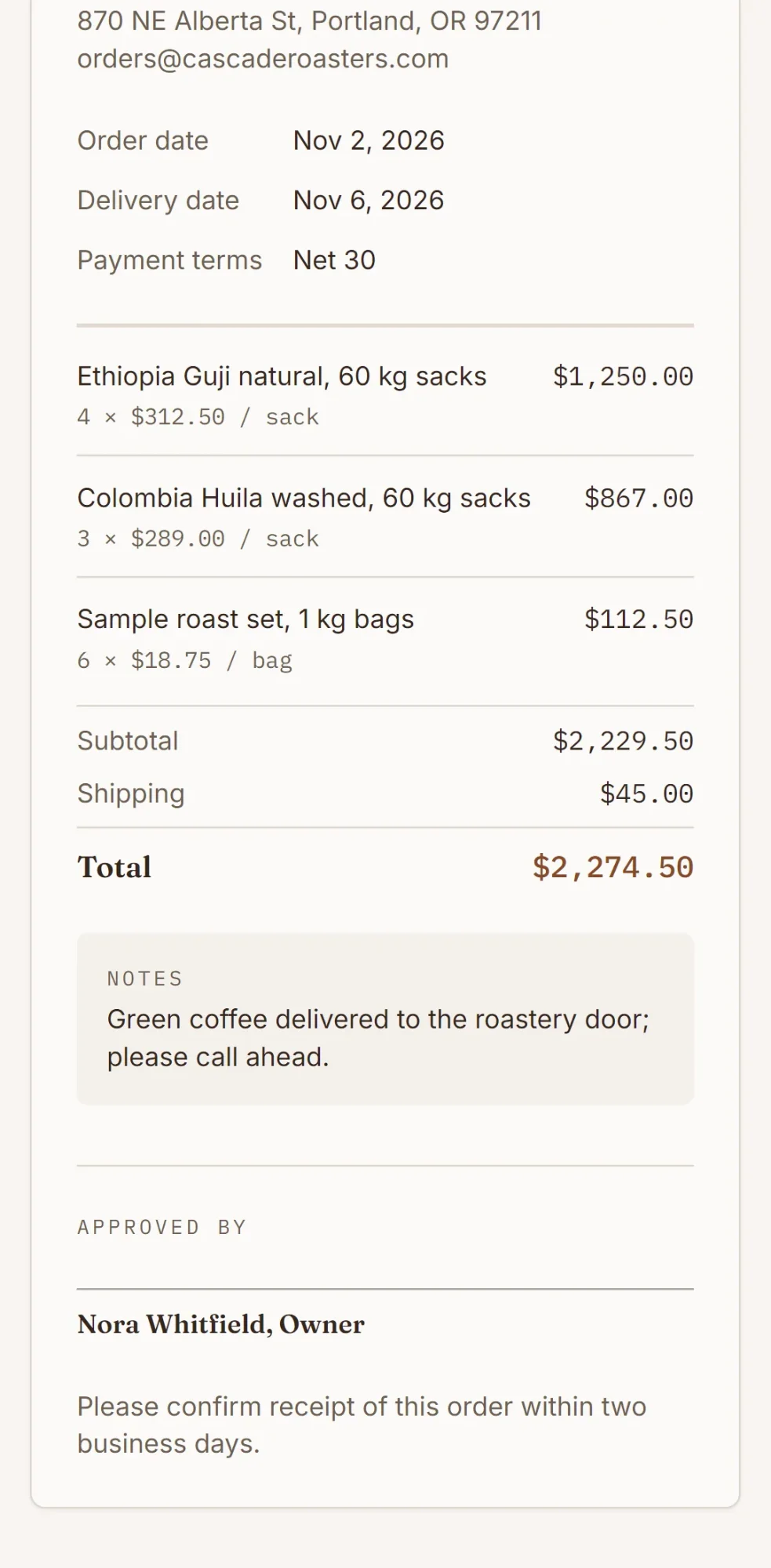
This example starts from the PO the demo produced, PO-2026-001 from Driftwood Coffee, an invented coffee shop in Portland, Oregon, with a fourth line item added for the template (the demo screenshot shows three). The header comes first, then the line items.
- Buyer: Driftwood Coffee, 1420 SE Division Street, Portland, OR 97202. orders@driftwoodcoffee.com, (503) 555-0142.
- PO number: PO-2026-001
- Order date: November 2, 2026
- Delivery date: November 6, 2026
- Vendor: Cascade Roasters, contact Maya Ellison, 870 NE Alberta St, Portland, OR 97211.
- Payment terms: Net 30
| Item | Unit | Qty | Unit price | Amount |
|---|---|---|---|---|
| Ethiopia Guji natural, 60 kg sacks | sack | 4 | $312.50 | $1,250.00 |
| Colombia Huila washed, 60 kg sacks | sack | 3 | $289.00 | $867.00 |
| Sample roast set, 1 kg bags | bag | 6 | $18.75 | $112.50 |
| Cone paper filters, box of 1,000 | box | 4 | $37.50 | $150.00 |
| Subtotal | $2,379.50 | |||
| Shipping | $45.00 | |||
| Total | $2,424.50 |
- Approved by: Nora Whitfield, Owner.
- Notes: green coffee delivered to the roastery door; please call ahead.
- Closing line: please confirm receipt of this order within two business days.
To copy it, swap in your own details and keep the structure. The math is simple: each amount is quantity times unit price, the subtotal adds the amounts, and the total adds shipping. This sample has no sales tax line. If your purchase is taxable where you are, add a line for it and check the rate with your accountant. All names and amounts are invented.
04. How to make a purchase order, step by step
To make a purchase order, decide what you need, confirm the price with the vendor, fill in the details under the next PO number, get approval and send it. Follow these steps:
- Decide what you need and how many, with the exact unit (sack, bag, case).
- Confirm price and lead time with the vendor. If you have an estimate, take the prices from it.
- Assign the next PO number in your series.
- Fill in the buyer and vendor details and the order and delivery dates.
- Add the line items with quantity, unit and unit price, then work out the subtotal, shipping and total.
- Write the payment terms and the delivery notes.
- Get approval from whoever has authority to spend.
- Send it to the vendor by email or text, and keep a copy.
- Update its status as it moves: sent, received, paid.
Before ordering more, check what you already have: inventory management tells you what to reorder and how much.
05. Types of purchase orders
The four types of purchase orders most often listed are the standard, planned, blanket and contract PO. This is the common classification in the trade, not a rule, and companies name them differently.
- Standard PO: a one-off purchase with defined items, quantities and dates. It is the one in the example.
- Planned PO: issued when the purchase is expected, but delivery dates get set later.
- Blanket PO: authorizes repeat purchases from one vendor up to an amount or a period, without a new paper each time.
- Contract PO: issued under a master agreement already signed, with the prices agreed there.
A small business almost always starts with the standard PO.
06. Purchase order vs invoice, quote and packing slip
A purchase order is issued by the buyer to place an order; a quote, an invoice and a packing slip are issued by the vendor. Each belongs to a different moment in the deal:
| Document | When | Issued by | What it does |
|---|---|---|---|
| Quote or estimate | before buying | vendor | offers a price, no order yet |
| Purchase order | when you decide to buy | buyer | places and authorizes the spend |
| Packing slip | at delivery | vendor | shows what arrived |
| Invoice | when billing | vendor | requests payment |
The most common mix-up is purchase order vs invoice. The PO says what the buyer wants to buy; the invoice says what the vendor is charging.
07. What happens after the PO: receiving, invoice and payment
After you send the PO, the process continues with receiving the goods, the vendor's invoice and payment. The control practice that ties it together is called a three-way match: comparing the PO, the packing slip (what arrived) and the invoice (what you are billed) before paying.
- Receiving: when the goods arrive, check quantities and condition against the PO and the packing slip.
- Invoice: when the vendor bills you, compare line items and prices with the PO.
- Payment: if all three agree, pay on the agreed terms; if not, resolve the difference first.
- Status: mark the PO received and then paid, so you know what is still open.
To see how those payments hit your bank balance, use a cash flow template.
08. The legal side: a PO is an offer, and it does not replace the invoice
In the United States, a purchase order works as an offer to buy, and the Uniform Commercial Code (UCC) governs sales of goods. The UCC is reproduced by the Cornell Law School Legal Information Institute, which is not a government site, and each state adopts its own version.
- Under UCC 2-206, an order or other offer to buy goods for prompt or current shipment is construed as inviting acceptance either by a prompt promise to ship or by prompt shipment. In other words, the vendor can accept your PO by promising to ship or by shipping.
- Under UCC 2-201, a contract for the sale of goods for the price of $500 or more is not enforceable unless there is a writing sufficient to indicate that a contract has been made, signed by the party against whom enforcement is sought. A written, approved PO is the kind of record that helps here. The $500 threshold is the uniform text, so check your state.
- Under UCC 2-204, a contract for sale of goods may be made in any manner sufficient to show agreement, including conduct by both parties.
None of this makes the PO an invoice. The invoice is the vendor's bill, and the PO does not replace it. For specifics on your deal, check with a lawyer.
The demo does not issue invoices or tax documents either: it creates the purchase order and its link.
Put it into practice: a purchase order app with link and panel
This is the exact prompt used in wanno for Driftwood Coffee:
I want an app to create purchase orders for my coffee shop in Portland, Driftwood Coffee: my business details and the vendor's, an automatic PO number, order date and delivery date, line items with quantity, unit and unit price in US dollars, subtotal, shipping, total, payment terms like Net 30 and who approved it. Each PO has its own link to send to the vendor, it can be printed or saved as PDF, and there is a panel with every PO and its status (sent, received, paid). Load 3 sample purchase orders and save everything in the cloud. The link of each PO opens without signing in and only the panel asks for a password. Everything visible in the app must be in English.
wanno built it on its own: 3 minutes 10 seconds, 52 steps and $0.35 in total. That includes adjustments to fix the dates of the public document, which came out blank, and to fit the line items on a phone screen. It ran on its test link.
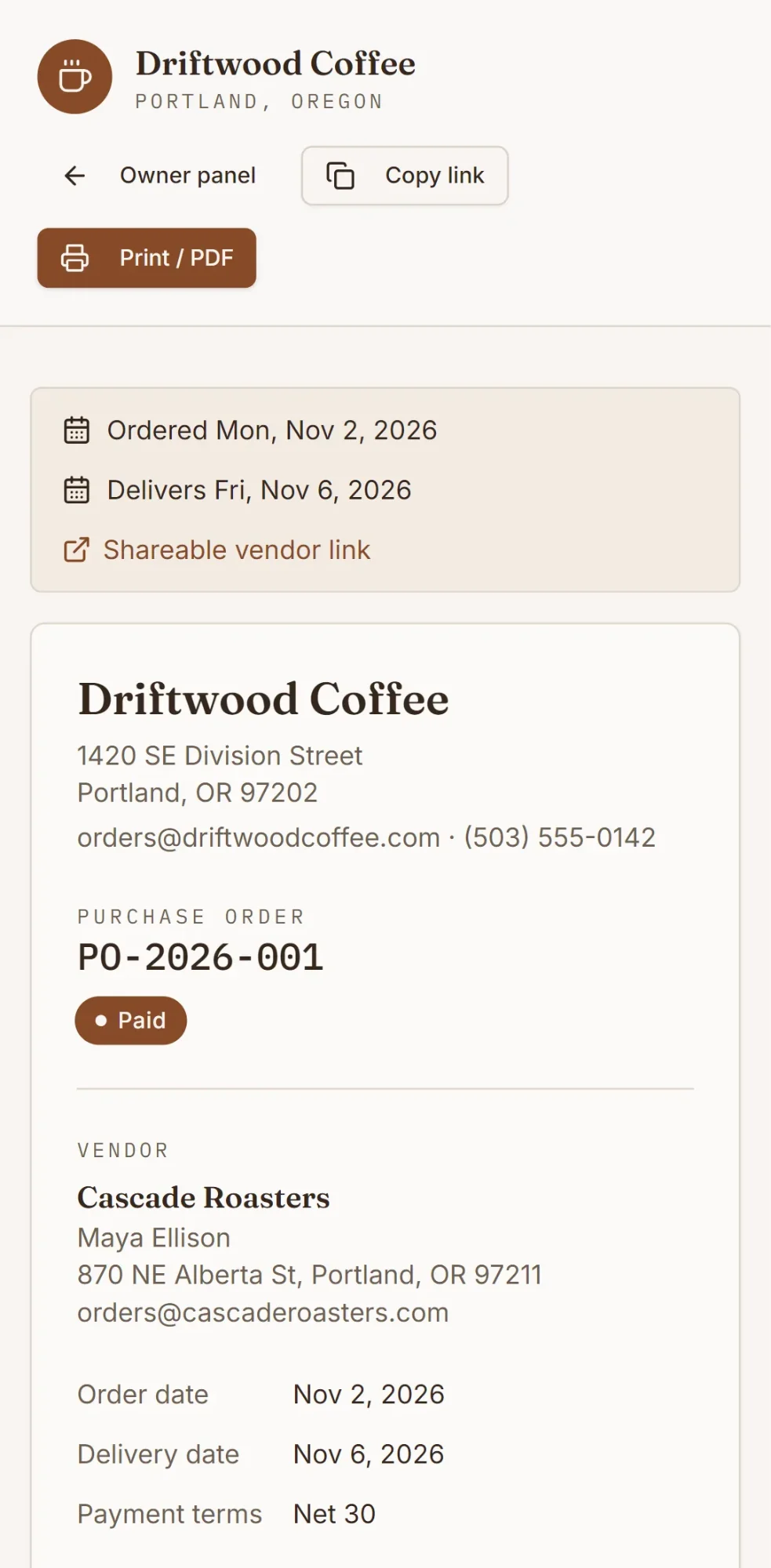
What you get is an app with an automatic PO number (PO-2026-001 and on), your details and the vendor's, order and delivery dates, line items with quantity, unit and unit price, and subtotal, shipping and total updating live. It suggests payment terms such as Net 15, 30 or 45, and records who approved it, plus notes.
Each PO has its own link that the vendor opens without signing in, with Print / PDF and Copy link buttons. The owner panel, which activates when you choose your password, lists every PO with its status (sent, received, paid), with filter and search. Two limits: this version does not calculate sales tax, since the prompt did not ask for it, and it does not edit POs once saved. The coffee shop, the vendor and the amounts are examples, and it is good practice to test one of your own orders before sending it.
The cost: $0.35 is paid once and fits within two days of free credit. For comparison, the wanno Starter plan costs $4.99 a month with $10 in credits included, about $0.17 a day, every day (see plans).
Create your purchase orders in wanno
Describe your business, your vendors and your terms in wanno, and have your first purchase order ready to share.
Frequently asked questions
What is a purchase order? A purchase order is the document a buyer sends a vendor to order goods or services. It states what is ordered, how many, at what price, by when and on what payment terms. With wanno you can build yours, with an automatic PO number and a link to send.
How do you write a purchase order? Decide what you need, confirm price and lead time, assign a PO number, fill in both parties' details and the line items, work out subtotal, shipping or tax and total, get approval and send it to the vendor. The example in this guide gives you the full structure to copy.
What is the difference between a purchase order and an invoice? A purchase order is issued by the buyer to place an order; an invoice is issued by the vendor to request payment. The PO states what the buyer wants, the invoice states what the vendor charges, and the PO does not replace the invoice.
What is the difference between a PR and a PO? A purchase requisition (PR) is an internal request asking for permission to buy; a purchase order (PO) is the document sent to the vendor once the buying is approved. This is common company practice, not a legal rule, and small businesses often skip the PR.
Can I make one for free?
Yes. The wanno free plan gives a daily credit of $0.30 with a monthly cap of $1.50, and the app in this guide cost $0.35, which fits in two days of free credit. On the free plan the page lives on a wanno.dev subdomain and carries the "Built with wanno" badge. You pay if you want to remove the badge, use your own domain or ask for more changes than the credit covers.
Is a purchase order legally binding? It can be: in the United States, under the UCC, a PO works as an offer, and the vendor accepts it by promising to ship or by shipping. For sales of $500 or more, the UCC text calls for a signed writing, and each state adopts its own version, so check yours.
Read next: How to price a product