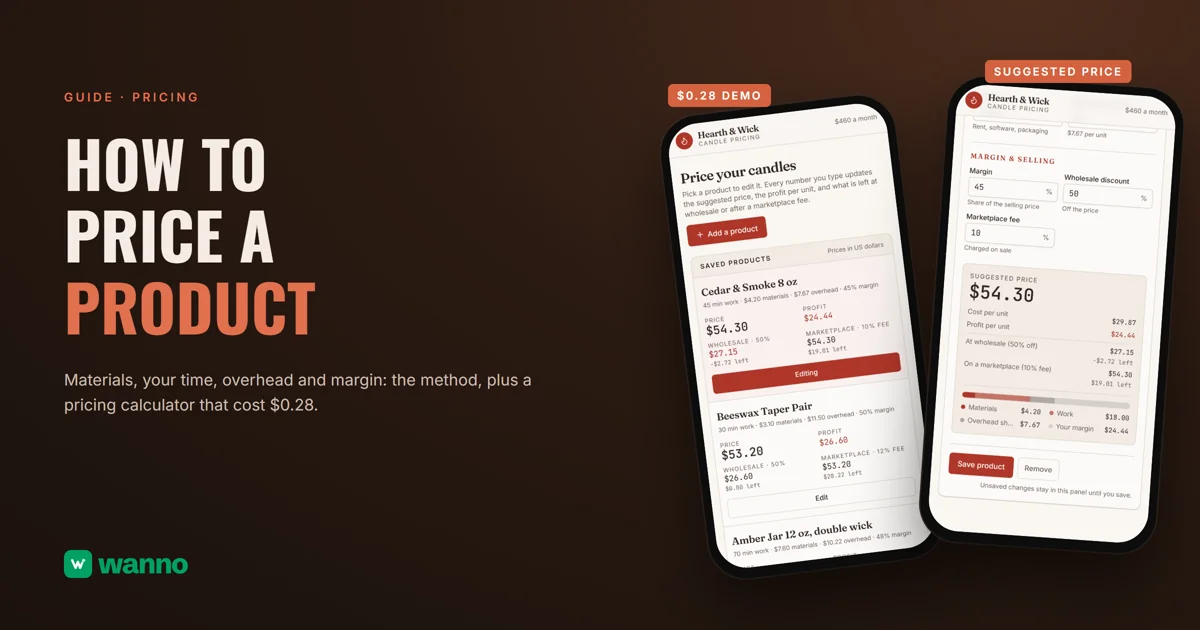
If you're searching for how to price a product, you probably already sell and keep wondering whether to match what others charge or charge what you actually need. This guide gives you the formula, a worked example, a cost table to copy, and the pricing strategies people really use. To skip the manual math, it uses Hearth & Wick, an example candle business: its pricing calculator, with 5 sample products, was built in 1 minute 44 seconds, with two adjustments included, and cost $0.28. Updated November 17, 2026.
In short: To price a product, add materials, your labor and your share of overhead to get the total cost, then use the formula price = total cost ÷ (1 - margin). With a $20 cost and a 50% margin on the price, the price is $40 and the profit is $20. If the percentage is applied on cost (markup), the formula is total cost × (1 + markup), and the same 50% gives $30.
The short version, with made-up numbers: a candle costs you $20 to make and you sell it for $40. Here is what is left depending on how you sell it.
| How you sell it | You charge | Profit left |
|---|---|---|
| List price | $40 | $20 |
| 10% off | $36 | $16 |
| Wholesale, 40% off | $24 | $4 |
| Etsy (US payment account) | $40 | $15.75 |
01. How to price a product: the mistake of starting from someone else's price
The most common mistake is to look at what a competitor charges and pick something close, or to add a little to what the wax and jars cost. That doesn't tell you whether your hours are paid or whether you end the month in the black. Start from your own cost. Competitors show you the range your customers are used to, not whether that range works for you.
02. The pricing formula: margin vs. markup
To price a product, add up everything it costs you (materials, your labor, your share of overhead) to get the total cost, then apply the profit you need. There are two formulas, depending on whether that profit is measured against the selling price (margin) or against the cost (markup).
Price = total cost ÷ (1 - margin)
Example: a total cost of $20 and a 50% margin on the price. $20 ÷ (1 - 0.50) = $20 ÷ 0.50 = $40. Profit is $20, half of $40.
Price = total cost × (1 + markup)
Example: the same $20 cost and a 50% markup on cost. $20 × 1.50 = $30. Profit is $10, which is only 33% of the price.
Same "50%," very different prices. To convert one to the other: markup = margin ÷ (1 - margin). A 50% margin equals a 100% markup (0.50 ÷ 0.50 = 1). Use margin when you want to know what share of the customer's payment is yours, and markup when you think in terms of what you add on top of cost. Either way, check what a percentage applies to before you trust it. If you also quote custom orders, the same math helps when you write an estimate.
03. How do I price a product for a 20% profit?
To keep 20% of the selling price as profit, divide your total cost by 0.80; adding 20% to the cost leaves you only 16.7% of the price. Example with a total cost of $25:
- 20% of the selling price (margin): $25 ÷ (1 - 0.20) = $25 ÷ 0.80 = $31.25. Profit is $6.25, and $6.25 is 20% of $31.25.
- 20% on top of cost (markup): $25 × 1.20 = $30. Profit is $5, which is 16.7% of the price.
The common slip is multiplying the cost by 1.20 and assuming you keep 20% of the price: you actually keep 16.7%. To keep 20% of the price, the markup you need is 25% ($25 × 1.25 = $31.25, the same result as the margin formula).
04. How to calculate the cost per unit of a product
This works the same for a handmade product and for a food product. Count everything it takes to make one unit, even if you don't pay for it out of pocket every day.
Step 1: materials per unit. Add up everything that goes into one item, packaging included. If you buy in bulk, divide by the number of items it makes. If you sell food, include waste: what gets thrown away or goes unsold. Example: $6 per candle.
Step 2: your labor. Multiply the minutes one item takes by what you want to earn per hour. Example: 30 minutes at $20 an hour is $10. If you don't pay yourself, the business is just giving your time away.
Step 3: your share of monthly overhead. Rent, software and shipping supplies are spread over the units you sell in a month. Example: $400 a month over 100 units is $4 per unit. If you sell fewer than you planned, each unit carries more overhead. The SBA's formula for the break-even point is fixed costs divided by (sales price per unit minus variable cost per unit), so you know how many units you need each month. See also this cash flow template, and if you make in batches, track your inventory so you know what materials really cost.
Example total: $6 + $10 + $4 = $20 cost per unit. Below that number you lose money. Marketplace fees are left out here because they change with each channel: they come in step 4. If you absorb shipping, add it as one more cost of that channel.
05. How to price your products: cost, competition, perceived value and psychology
There are four common pricing strategies: cost-based, competition-based, value-based and psychological pricing. All of them start from your total cost, which is the floor, and decide how far above it to price.
- Cost-based. Total cost plus profit, as in the formulas above. It's the safest, because every sale covers what it costs you.
- Competition-based. Look at what similar sellers charge, but compare like with like: size, materials, packaging, shipping time. Don't copy a price blindly: you don't know their costs or whether they make money.
- Value-based. If your customers care about the design, the materials or the story, they may pay more than the minimum. Your total cost is still the floor.
- Psychological pricing. Ending a price in 9 ($39 instead of $40) is a common practice that some shoppers read as cheaper. It's a rule of thumb, not a law: test it and see if you sell more. Round after you calculate, and check that the profit still covers what you need.
A strategy picks the price within a range, and your total cost sets the floor. That's why it helps to have the math at hand before each decision.
06. What's left in each channel: discounts, wholesale, Etsy fees and sales tax
Step 4: the channel. The list price isn't always what you collect. With a $20 cost and a $40 price:
- 10% off brings the price to $36 and the profit to $16.
- A wholesale order at 40% off sells at $24 and leaves $4. At 50% off you'd be at $20 and earn nothing.
- A marketplace takes fees. On Etsy, according to its fees page (https://www.etsy.com/legal/fees/, as of November 2026), you pay a listing fee of $0.20 per item and a transaction fee of 6.5% of the price you display plus the amount you charge for shipping and gift wrapping. Etsy's payment processing page lists 3% + $0.25 for an account in the United States, in addition to the 6.5%. Fees change: check the pages first. On a $40 candle, ignoring shipping and sales tax: $0.20 + $2.60 + $1.20 + $0.25 is $4.25, so you keep $35.75 and the profit is $15.75. Etsy's processing fee is also charged on any sales tax the buyer pays: with a made-up 8% tax, it's 3% of $43.20, or $1.30, and the profit drops to $15.65.
Step 5: tax. Tax is added on top of your price. In the US it varies: the SBA notes that "income tax, sales tax, property tax, and corporate taxes can vary significantly from place to place", so look up the rate where you sell. At a made-up 8%, a $40 candle costs the customer $43.20. Whether you collect it yourself depends on where you sell and how: ask an accountant before you publish prices.
07. A product pricing template to copy: calculate it in Excel or Google Sheets
Copy this table into a spreadsheet and swap the sample numbers for yours. The product is an example candle.
| Item | How to calculate it | Example |
|---|---|---|
| Materials per unit | Bulk purchase ÷ units it makes | $6 |
| Your labor | Minutes ÷ 60 × your hourly rate | 30 min ÷ 60 × $20 = $10 |
| Overhead per unit | Monthly overhead ÷ units sold per month | $400 ÷ 100 = $4 |
| Total cost | Sum of the three rows | $20 |
| Target margin | Share of the price | 50% |
| Price | Total cost ÷ (1 - margin) | $20 ÷ 0.50 = $40 |
| Etsy fees (US, no shipping or sales tax) | $0.20 + 6.5% of price + 3% of price + $0.25 | $0.20 + $2.60 + $1.20 + $0.25 = $4.25 |
| What you receive | Price - fees | $35.75 |
| Real profit | What you receive - total cost | $15.75 |
| Price with sales tax | Price × (1 + tax rate) | $40 × 1.08 = $43.20 (8% is made up) |
To do it in a spreadsheet, put materials in B2, labor in B3 and overhead in B4. Total cost is =B2+B3+B4 in B5, the margin goes in B6 (typed as 0.5) and the price is =B5/(1-B6) in B7. Change any number and everything updates. That's what the calculator in the next section does, without the formulas showing.
Put it into practice: a pricing calculator built with wanno
We built the pricing calculator with wanno, a platform that builds websites and apps with AI from your phone, with this message:
I want a pricing calculator for my handmade candle business, Hearth & Wick: for each product I enter the cost of materials, the minutes of work and what I want to earn per hour, a share of my monthly fixed costs (rent, software, packaging) is added based on how many units I sell, I pick the margin I want, and it shows the suggested price in US dollars, the profit per unit and what is left if I sell at wholesale or on a marketplace that charges a fee. I can save my product list with prices. Load 5 sample products. Everything visible in the app must be in English.
wanno built it in 1 minute 12 seconds. The total of 1 minute 44 seconds, 22 steps and $0.28 in credits includes two adjustments: one to the fixed costs header at the top, and one so the margin label reads "Share of the selling price". That fits within one day of free credit. It ran on its test link. The top of the app lists your saved products, and each one shows its minutes of work, materials, overhead and margin, with the price, the profit, and what is left at wholesale and on a marketplace.
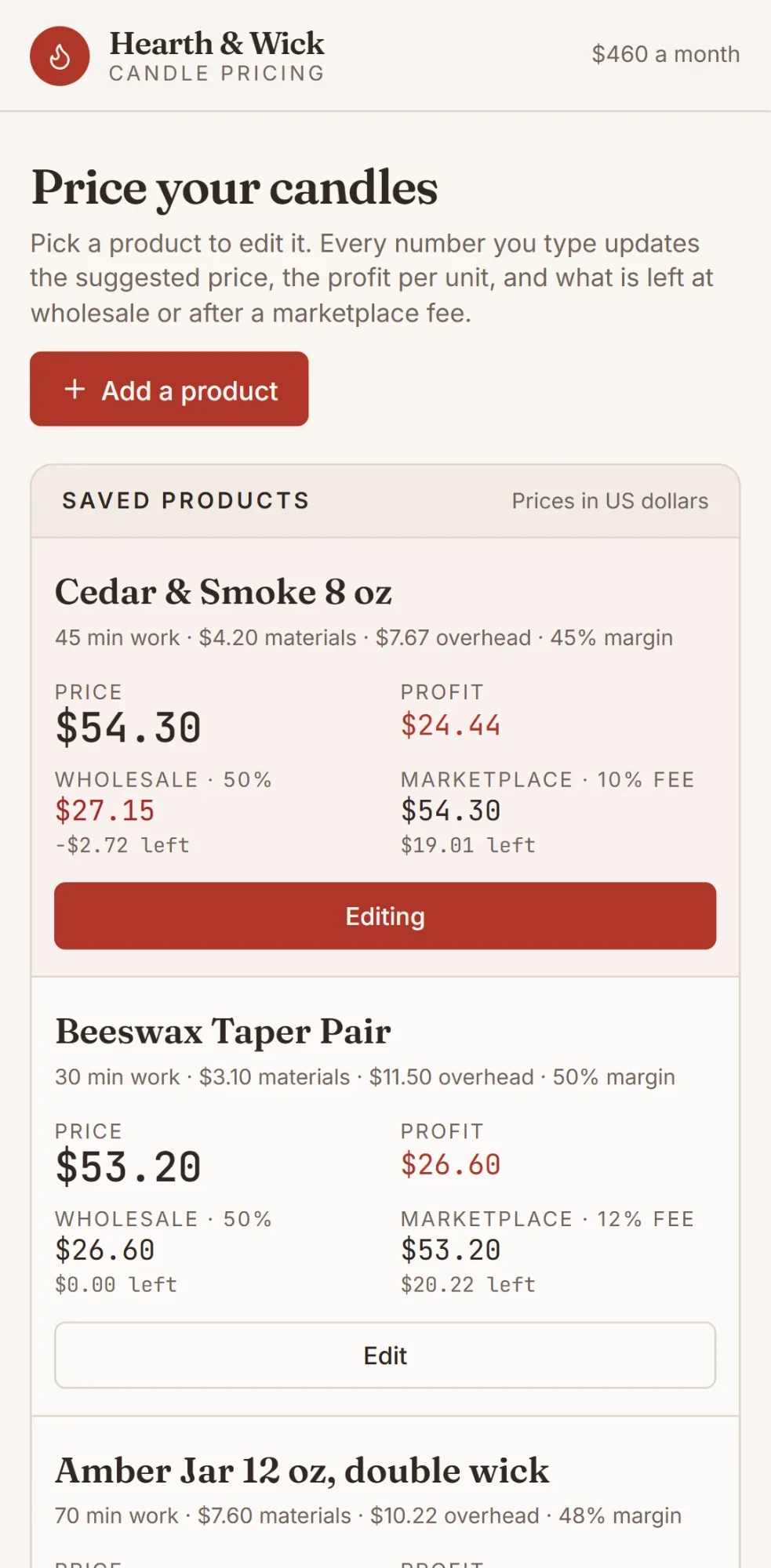
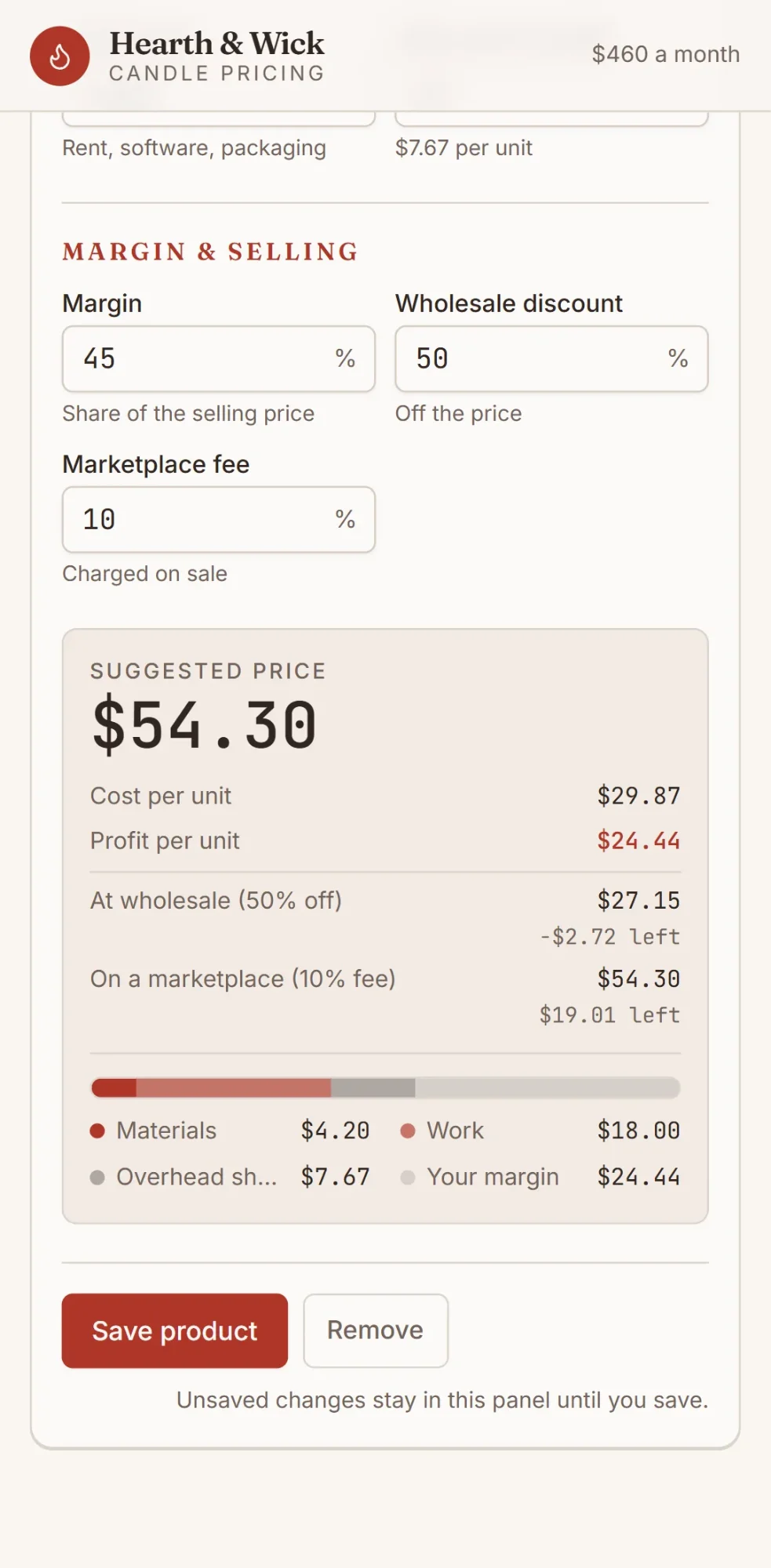
Look at Cedar & Smoke 8 oz: 45 minutes of work, $4.20 in materials and $7.67 in overhead come to $29.87 per unit. At a 45% margin it sells for $54.30 with $24.44 of profit: the margin is taken on the price (cost ÷ 0.55, rounded to the cent only at the end). But at 50% off for wholesale it sells for $27.15, less than the cost, so it shows -$2.72 left. On a marketplace with a 10% fee, $19.01 is left. That's exactly why you run the numbers before you say yes to a wholesale deal. Every number updates as you type. Your list is saved on the server, so you see the same list from another device. Products, names and prices are examples.
Your pricing calculator in minutes
Describe your business in wanno with your materials, your hours and your sales channels, and have your own calculator before you set your next price. It's free to try.
Frequently asked questions
How do I calculate the price of a product? You calculate the price of a product by adding up your cost per unit (materials, your labor and your share of overhead), applying the margin you need, then checking what is left after fees, discounts and tax. With a $20 cost and a 50% margin, the price is $40.
How do I calculate the cost of a product? Cost per unit = materials + labor + overhead per unit. Divide each bulk purchase by the units it makes, multiply the minutes by your hourly rate, and spread monthly overhead over the units you sell. Example: $6 + $10 + $4 = $20.
What is the formula for pricing a product? With a margin on the price: price = total cost ÷ (1 - margin). With a markup on the cost: price = total cost × (1 + markup). The same cost gives different prices, so always check which base your percentage uses.
How do I get a 20% profit on a product? To keep 20% of the price, divide the total cost by 0.80: a $25 cost gives $31.25 and $6.25 of profit. Adding 20% to the cost gives $30 and $5 of profit, only 16.7% of the price. The wanno calculator does this math each time you change a number.
Should my price include sales tax? In the US, sales tax is usually added at checkout on top of your price, and the rules vary by place. Price without tax, add it on top to see what the customer pays, and confirm the rules where you sell.
Is there a free way to build the calculator?
Yes. wanno's free plan gives a daily credit of $0.30 with a monthly cap of $1.50, and this guide's calculator cost $0.28. It lives on a wanno.dev subdomain with a "Built with wanno" badge. You only pay if you want to remove the badge, use your own domain, or ask for more changes than the free credit covers: the Starter plan is $4.99 a month with $10 in credits included (see plans).
Read next: How to build a digital catalog