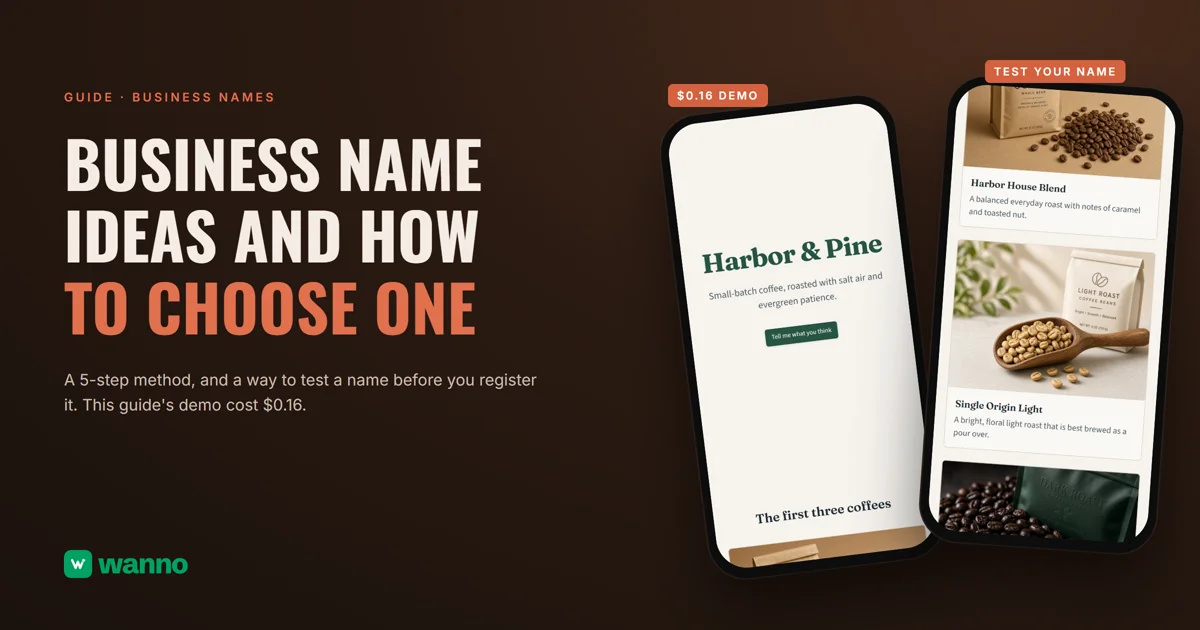
If you're hunting for business name ideas, coming up with one is rarely the hard part. The hard part is landing on a name that won't cause trouble later: one another company already uses, one too generic to protect, or one your customers shrug at. This guide gives you a 5-step method, a list of example names by type of business, how to check the trademark with the official office and what it costs, and a cheap way to test the name on real people before you register it. The name-test page for Harbor & Pine took 1 minute 23 seconds to build and cost $0.16.
The short version:
| Step | What you do | What it saves you from |
|---|---|---|
| 1. Define | Write what you sell, who it's for and the feeling you want | Names that sound nice but say nothing |
| 2. Generate | List 15 to 20 candidates mixing what you do, an image and a place | Settling for the first idea |
| 3. Filter | Drop the generic, the hard to say and the look-alikes | A name you can't protect |
| 4. Check | Search the trademark and the domain | Paying a filing fee for a name that gets refused |
| 5. Test it | Show the name on a page and collect opinions | Registering something your customers don't connect with |
| wanno's limits | The free plan publishes on a wanno.dev subdomain with the "Built with wanno" badge |
Surprises: your own domain and removing the badge are paid |
01. Why the name deserves an afternoon before you print anything
A name ends up everywhere: the sign, the bags, the Instagram handle, your website address. Changing it once you have customers means redoing all of it.
Three things make a name fail. It can be too generic: the USPTO says that weak trademarks are hard to protect against competitors and often are not federally registrable. It can be too close to an existing mark: according to the USPTO, likelihood of confusion is the most common reason for refusing registration. Or nobody can remember or spell it.
02. Business name ideas: the 5-step method
Step 1: define it in one sentence. Write what you sell, who it's for and the feeling you're after: "small-batch coffee for people who like a slow morning".
Step 2: generate lots of candidates. Mix three ingredients: what you do (roast, thread, polish), an image that goes with it (harbor, pine, sparrow) and, if it helps, a place or a surname. Write down 15 to 20 without judging.
Step 3: filter. Cut the ones that describe instead of name ("Best Coffee Shop"), the ones you can't spell over the phone and the ones that look a lot like a well-known brand. Say each one out loud.
Step 4: check. With 3 or 4 finalists, search the trademark with the official office and check the domain. More on that below.
Step 5: test it on real people. Before paying a filing fee, show the name to likely customers and ask what they think. Changing a name that's already registered costs far more.
Example names by type of business
These show the style. They aren't cleared names, so run any favorite through step 4.
- Cafés: Brass Sparrow, Juniper Door, The Quiet Grind.
- Shops: Tin Lantern, Pocket Hardware Co., Otter Lane.
- Bakeries: Lark & Barley, Salt Meadow, Hollow Oak.
- Nails and beauty: Moth & Marigold, Velvet Anchor, Plum Orbit.
03. How to check the trademark before you file
In the US the office is the USPTO. Start with its trademark search and look for your finalists and for variations that sound or look alike. Filing has a fee: $350 per class. Confirm the current amount on the USPTO site before you pay.
Registering a trademark is separate from registering the business with your state: for that side, the SBA has a guide on how to choose your business name. Check the domain and the Instagram handle too: if the name is taken there, people will have a harder time finding you. Once you've picked, here's how to connect a custom domain to your site from your phone.
04. Test it before you register it
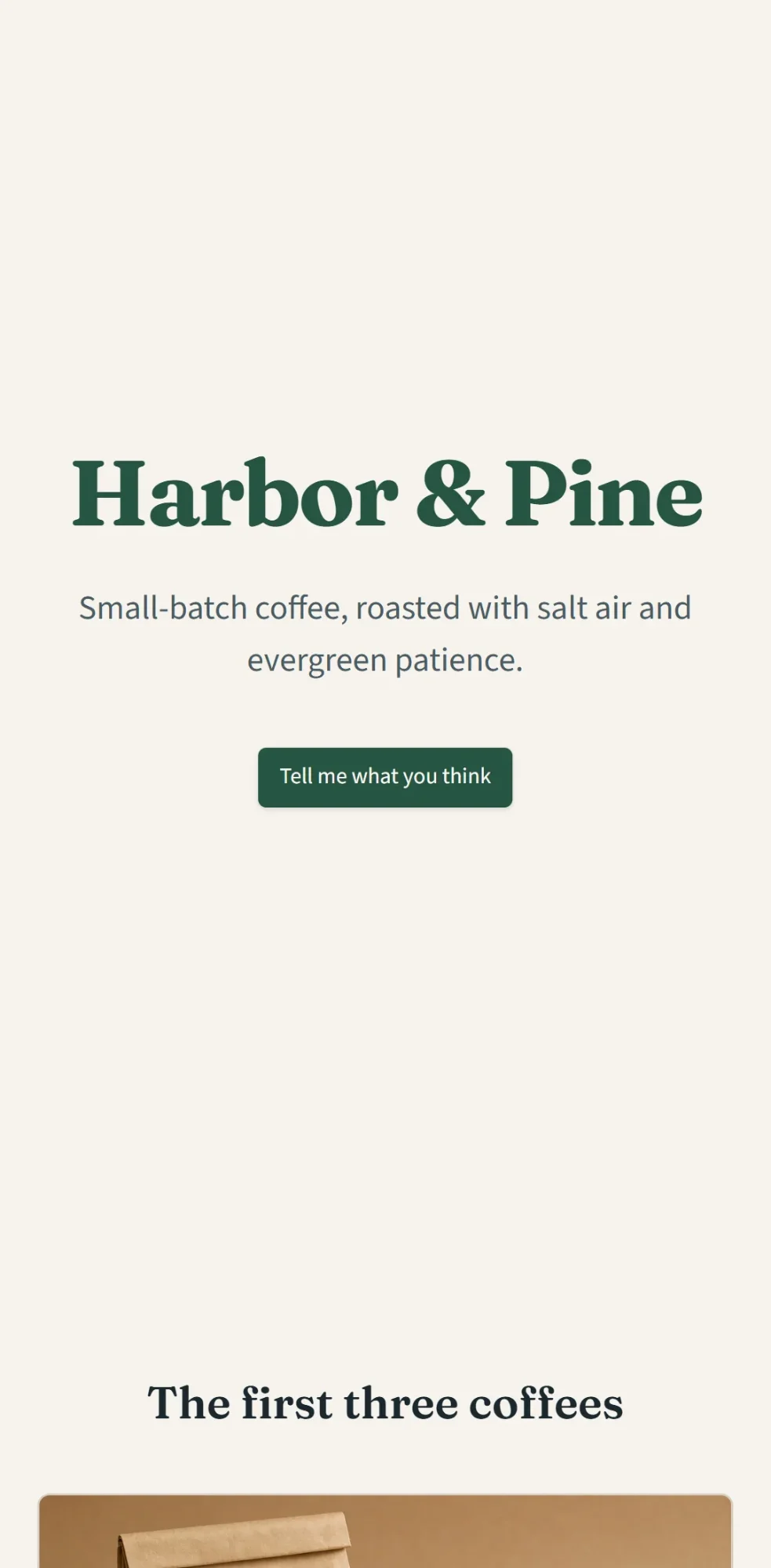
With your finalists in hand, the most useful step is left: finding out what people think. With wanno you describe a test page in one message, from your phone, and the platform builds it. Here's the request for this one:
I want a page to test the name of my new coffee roasting business, Harbor & Pine, before I register it: the name big on top, a short tagline, three coffees with photos, a form where people leave their email and tell me what they think of the name, and a private panel to see the answers. Everything visible in the app must be in English.
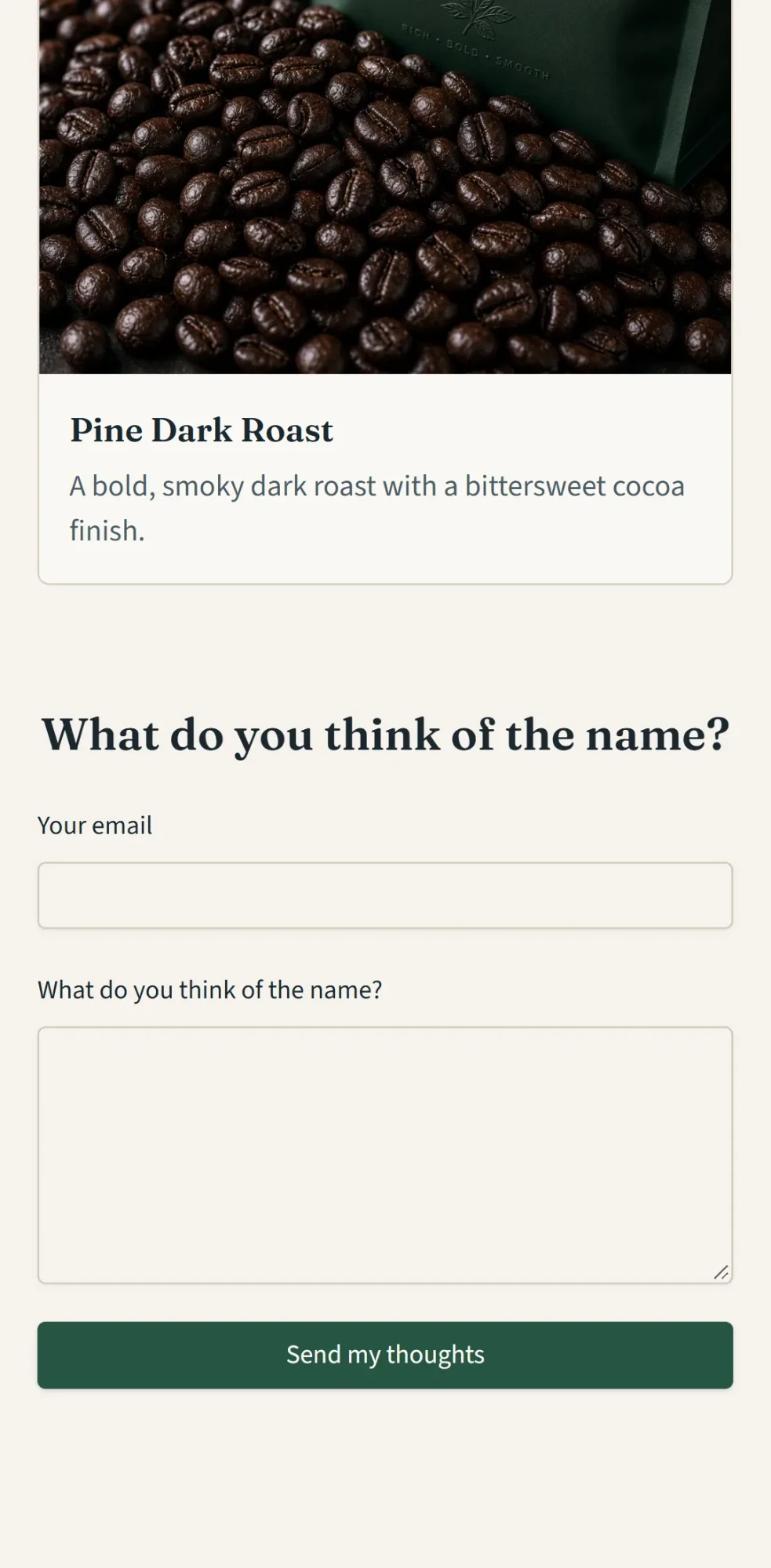
wanno built it on its own: 1 minute 23 seconds, 22 steps, and the page ran on its preview link, with "Harbor & Pine" in large type, the tagline "Small-batch coffee, roasted with salt air and evergreen patience", three coffees with photos (Harbor House Blend, Pine Dark Roast and Single Origin Light) and a "Tell me what you think" button.
The form asks for an email and an open comment on the name, rejects invalid emails and shows a thank-you message after each send. Answers are saved, available from any device, and you get a notice for each one. You read them at /panel, which you activate by choosing a password: the total sits above the list. The business, the coffees and the photos are examples: you swap in your own.
One good habit: publish it on your wanno.dev subdomain, send a test answer yourself, then share the link with 15 or 20 people from your audience, not just family, and compare what comes back.
If two finalists tie, keep the one people remember and spell without help. And if all you want is opinions, a free Google Forms survey works too: the test page adds the name in context, the way a customer would see it.
05. What it costs to test a name
The build cost $0.16 (1.6 credits), which fits within one day of free credit: wanno's free plan gives $0.30 per day, with a monthly cap of $1.50. The page lives on a wanno.dev subdomain, with the "Built with wanno" badge. You only pay to remove the badge, use your own domain, or ask for more changes than the free credit covers.
For scale: $0.16 is paid once; wanno's Starter plan, at $4.99 per month with $10 of credits included (see plans), works out to about $0.17 per day, every day. And once the name is chosen, the next step might be a digital catalog with your products.
Your name, tested before you pay to register it
Picking a name well is a method, not a hunch: define, generate, filter, check with the USPTO and test it on real people. Describe your test page on wanno and see what your likely customers say; trying it is free.
Frequently asked questions
How do I come up with business name ideas? Mix what you do, an image and, if you like, a place, and write down 15 to 20 candidates. Then cut the generic and hard-to-say ones.
How much does it cost to trademark a business name in the US? The USPTO lists $350 per class. Confirm the current amount on its site before you file.
Can I use a generic name? You can use it, but may not be able to protect it: the USPTO says weak trademarks often are not federally registrable.
How do I test a name before registering it? With a test page and an opinion form, like Harbor & Pine's: it cost $0.16 and fits within one day of free credit.
Read next: Build an app from your phone, step by step
Download wanno on the App Store · Download wanno on Google Play