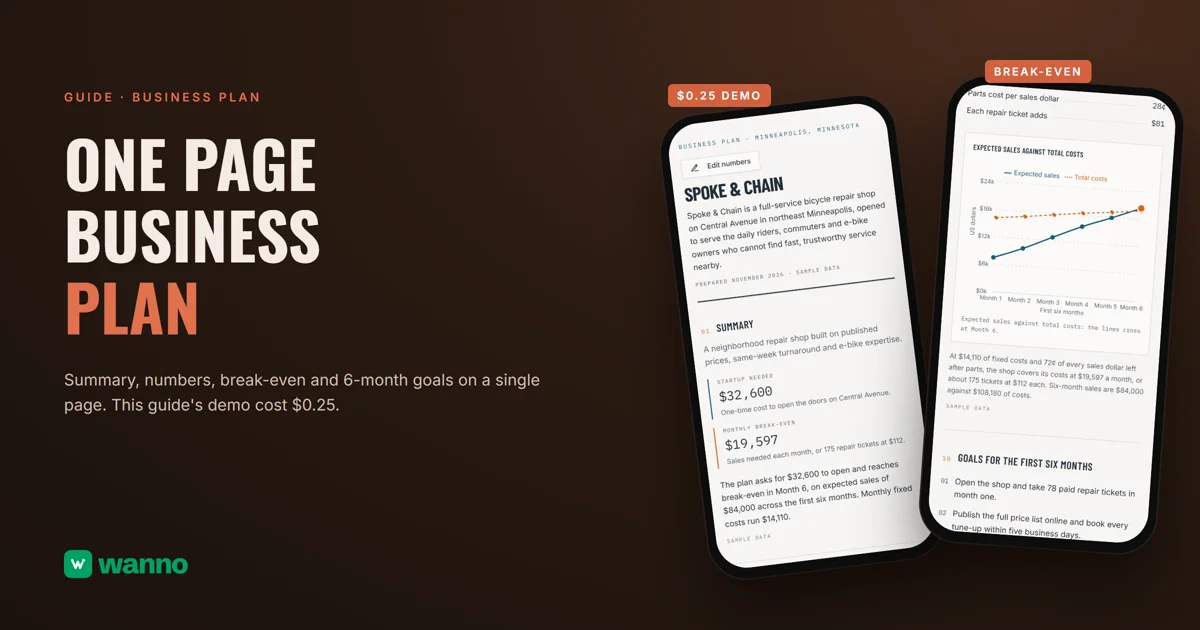
A one page business plan is the quickest way to find out whether your numbers work, and it is short enough to hand to a partner or a banker. This guide explains what it is, what it is for, what goes in it and how to calculate break-even, and it gives you a filled-in example and a template to copy. The example is Spoke & Chain, a sample bike repair shop in Minneapolis. Its plan, with a break-even chart and a panel to edit the numbers, was built in 1 minute 57 seconds for $0.25, with one adjustment included. Updated November 17, 2026.
In short: A one page business plan is a short document that sums up a business on a single page: what you sell, to whom, what it costs to start, what you expect to sell and when you break even. According to the SBA, lean plans are typically only one page, while traditional plans can be dozens of pages long. Break-even is calculated as fixed costs ÷ (sales price per unit minus variable cost per unit).
Side by side:
| Traditional plan | One page plan | |
|---|---|---|
| Length, per the SBA | "dozens of pages long" | "typically only one page" |
| Time | more work upfront | "as little as one hour" |
| Best when | you are applying for formal funding, or detail is part of the decision | you are deciding whether to go ahead, or opening a conversation with a partner |
| The limit | long, and hard to keep current | a summary: lenders may ask for more |
01. What is a one page business plan?
A one page business plan is a short document, often called a one-pager, that sums up your business on a single page: what you sell, to whom, what it costs to start, what you expect to sell and when you break even. It keeps only the points that decide whether the idea works.
It is not a lesser plan. It is the first version of a longer one, and for many small businesses it is all the planning they need to decide.
02. What a one page business plan is for
A one page business plan is for three things: deciding, raising money or finding partners, and lining up the team. It helps to know which one is yours before you write it:
- Deciding. It forces numbers onto the idea: what it costs to open, what you sell each month and when you stop losing money. If it does not add up, you find out before spending.
- Raising money or finding partners. The SBA, the U.S. Small Business Administration, says business plans can help you get funding or bring on new business partners.
- Lining up the team. With two or more people, the page writes down who owns what and which number everyone is working toward.
03. One page business plan format: what goes in it
A full plan usually walks through these parts. On one page, each gets a line or two:
- Executive summary. What you sell, where and how much you need. It goes first, but write it last, when you know what to sum up.
- Problem, customer and value. Who you help, with what, and why they would pick you.
- Offer and pricing. Exactly what you sell and at what price. If you are unsure, see how to price a product.
- Market and competition. Who sells something similar nearby and how you differ.
- Marketing and sales. The real channels you will use to find customers.
- Operations and team. Who does what, with which equipment, permits or suppliers.
- Startup costs. What you spend once to open the doors.
- Monthly fixed costs. What you pay even in a slow month: rent, payroll, insurance. To map when money comes in and goes out, see this cash flow template.
- Expected sales. How many units or jobs a month, at what price.
- Break-even and cash flow. The sales that cover your costs, and when you reach them.
- Goals. One measurable goal per month.
The SBA lists similar sections for a traditional plan: executive summary, company description, market analysis, organization and management, service or product line, marketing and sales, funding request and financial projections. If you do not have a name yet, these business name ideas can help. A plan feels unfinished without one.
04. Traditional plan, one page plan or lean canvas?
The SBA describes two common formats. Traditional plans use a standard structure and encourage you to go into detail in each section. They tend to require more work upfront and can be dozens of pages long. Lean startup plans focus on summarizing only the most important points of each key element: they can take as little as one hour to make and are typically only one page.
For the lean format the SBA names nine elements: key partnerships, key activities, key resources, value proposition, customer relationships, customer segments, channels, cost structure and revenue streams. That is the logic of the Lean Canvas, a one-page business model template created by Ash Maurya in 2010 and adapted from Alexander Osterwalder's Business Model Canvas for startups working under extreme uncertainty.
They are stages, not rivals. If you are not sure the business works yet, start with the page: it forces you to decide what counts. Before that, it helps to validate the idea with real customers. If a lender later asks for more depth, the page becomes the outline of the long version.
05. One page business plan example: Spoke & Chain
Here is how the page would read for Spoke & Chain, a made-up bike repair shop in Minneapolis:
- Summary: a full-service bike repair shop on a busy avenue.
- Problem and customer: daily riders and e-bike owners who cannot find fast, trustworthy service nearby.
- Offer and pricing: nine services with published prices, from a $28 flat repair to a $165 full tune-up.
- Competition: neighborhood single-mechanic shops within one mile have limited e-bike tooling and no published pricing.
- How it gets customers: foot traffic, local groups, referrals.
- Startup costs: $32,600 needed to start, in the sample plan.
- Monthly fixed costs: $14,110.
- Expected sales: $84,000 over the first six months, at an average ticket of $112.
- Break-even: $19,597 a month, which is about 175 repair tickets at $112.
- Six-month goals: one per month, such as publishing the full price list online and booking every tune-up within five business days.
Every figure is sample data, invented to show what a plan looks like, not numbers from a real shop. In the demo below you can see the full plan and its chart.
06. One page business plan template to copy
Copy this list into a document and answer each question in a line or two. Where an answer is hard to write, that is the work left to do.
- Summary. What do you sell, where, and how much money do you need to start?
- Problem and customer. Who has the problem and how do they solve it today? Why would they pick you?
- Offer and pricing. What exactly do you sell? At what price and margin?
- Competition. Who else solves the same problem nearby? Where are you better or different?
- Customers. Which channels will bring them in? What does each one cost to win?
- Operations and team. Who does what? What equipment, permits or suppliers do you need?
- Startup costs. What do you buy once? What money pays for it?
- Fixed costs. What do you pay each month even if you sell nothing?
- Expected sales. How many units at what price in a normal month? What is that based on?
- Break-even. How many sales do you need to avoid a loss? Is that reachable?
- Six-month goals. Which number do you want to see each month?
07. How to write a one page business plan, step by step
- Validate the idea with real customers before you put numbers on it.
- Gather your data: prices, costs, rent, payroll and what competitors charge.
- Fill in the template, from the first question to the last.
- Calculate break-even with the formula below.
- Write the summary last, and check that every figure is the same across the page.
- Test it on someone: a partner, a person in your trade or a banker.
08. Break-even formula and example
Break-even is the level of sales where you neither make money nor lose it. The SBA gives the formula. The same page adds that the break-even analysis is usually a requirement in order to take on investors or debt to fund your business.
Break-even point (units) = fixed costs ÷ (sales price per unit minus variable cost per unit)
A round example, made up to explain the math and not the numbers of any real shop:
- Monthly fixed costs: $3,000.
- Sales price per job: $50.
- Variable cost per job (parts): $20.
- Contribution margin: $50 minus $20 = $30 per job.
- Break-even: $3,000 ÷ $30 = 100 jobs a month, or $5,000 in sales.
Past job 100, every job adds $30 before taxes. If reaching 100 jobs looks out of reach, you know what to change: the price, the cost or the fixed costs. That decision is worth more than the document.
09. What lenders and partners look for in your plan
The SBA says lenders and investors commonly request the traditional plan, and that with the one page format some may ask for more information. So treat your page as the opening of the conversation and keep the detail behind it.
Anyone putting in money wants three things: that you know how much you need (startup costs), when you start covering your costs (break-even), and that your assumptions are reasonable (price, volume, costs). Make sure each number is identical across the page: nothing erodes trust like a break-even that says one figure in the summary and another in the chart. And label what is data and what is an estimate.
10. Common one page business plan mistakes
These come up again and again, and most are avoided with what this guide already covers:
- Writing the summary first. Write it last, when you know what to sum up.
- Sales with no basis. A volume that does not come from prices, customers or real capacity convinces nobody.
- No break-even calculation. Without it the plan cannot say whether the business holds up.
- Different figures in different places. If the summary says one thing and the chart another, no one trusts either.
- Estimates left unmarked. Separate what is data from what is an assumption.
Put it into practice: your one page business plan in wanno
You describe the plan in one message and wanno, a platform that builds websites and apps with AI from your phone, builds it on its test link. This guide's plan was requested like this:
I want a one-page business plan for my bike repair shop in Minneapolis, Spoke & Chain, to share with a partner or the bank: a summary, the problem and who I serve, what I offer and at what price in US dollars, the competition, how I will get customers, the startup costs, monthly fixed costs, expected sales, the break-even point with a chart and the goals for the first 6 months. Use sample data and add a panel to edit the numbers myself. Everything visible in the app must be in English.
wanno built it in 1 minute 57 seconds and 28 steps, for $0.25. That includes one adjustment, to fix the date and the punctuation in the demo text. It fits inside one day of wanno's free credit.
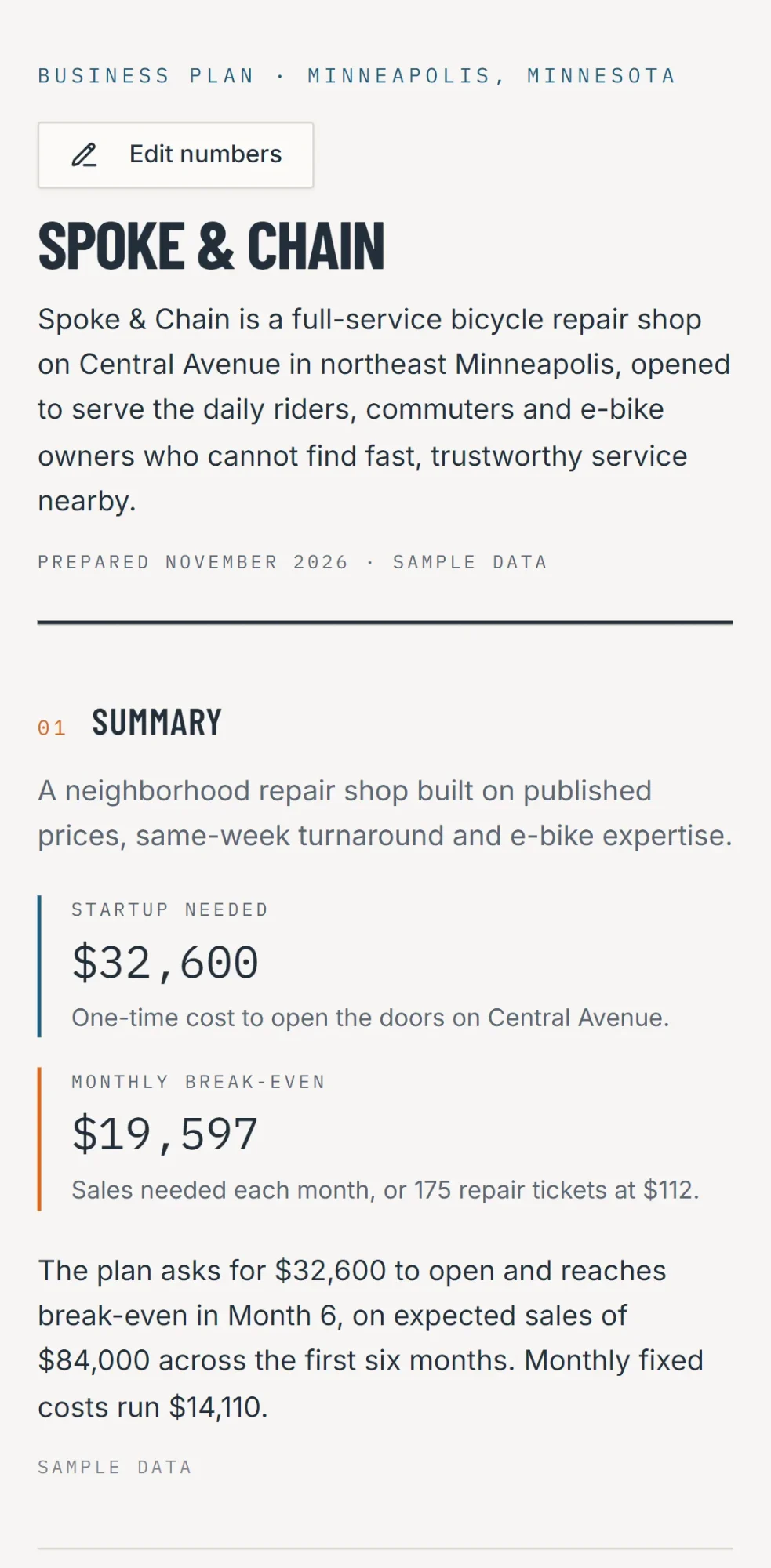
The result is a full plan on a single page. It opens with the summary and the key figures: $32,600 needed to start and a monthly break-even of $19,597, which is about 175 repair tickets at $112.
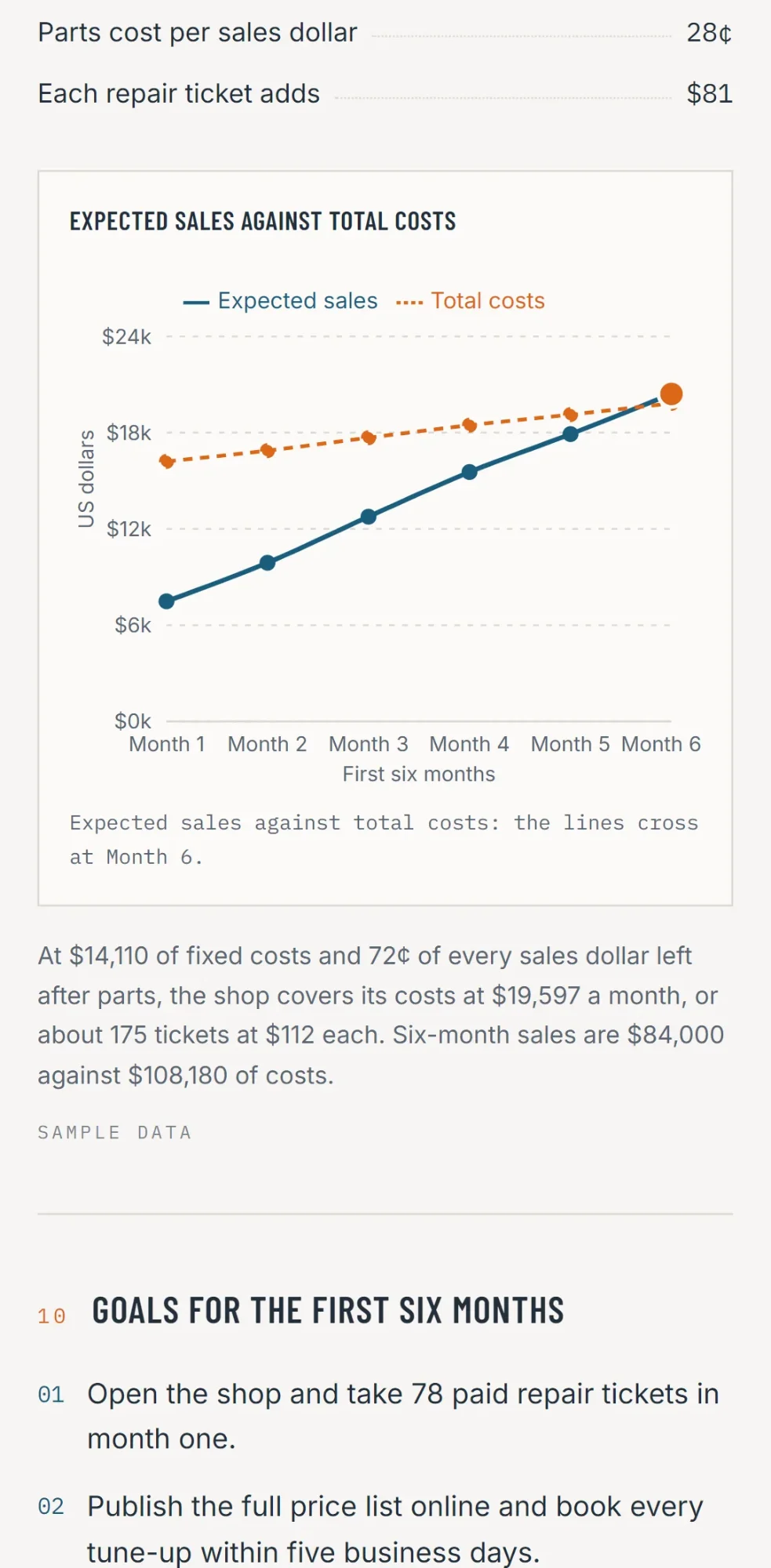
Further down, a chart sets expected sales against total costs over the first six months, and the lines cross at month 6. Read it the way a lender would: $84,000 of sales against $108,180 of costs means about $24,180 of early losses to fund on top of the $32,600 to open. The goals for those six months follow.
The figures are sample data and are saved in the cloud, so a partner or banker sees the same numbers from any device. To change them, you open the Edit numbers panel, which is activated by choosing your password, and the chart recalculates. Before sharing the link, open the plan once on your phone and check that every figure matches.
Build your one page business plan today
Describe your business in wanno and have a one page plan ready to decide with and to show. The free plan is enough to try it.
Frequently asked questions
What is a 1 pager in business? It is a single-page summary of a business or a plan: what you sell, to whom, what it costs to start and when you break even. It is the short version you hand to a partner, a lender or yourself. wanno turns that one-pager into a shareable page with a chart.
How do I create a one-pager for my business? Answer the eleven questions in the template, calculate break-even, write the summary last and check that every number matches. One page is enough to start. With wanno you describe the business in a message and get the plan built, with a panel to edit the numbers.
How long should a business plan be? It depends on what it is for. The SBA says lean plans are typically one page and traditional ones can run dozens. To decide and to talk with a partner, one page is enough; for formal funding you may need to expand it, and the wanno page is a solid base.
How do I write a one page business plan for free?
Use the template in this guide in a document or spreadsheet: it costs nothing. With wanno, the free plan gives a daily credit of $0.30, capped at $1.50 a month: this guide's sample plan cost $0.25. It lives on a wanno.dev subdomain with a "Built with wanno" badge; you pay only if you want to remove it, use your own domain or ask for more changes than the free credit covers. The Starter plan is $4.99 a month with $10 of credits included (see plans).
How do you calculate break-even? Break-even is monthly fixed costs ÷ (price per unit minus variable cost per unit). The result is the number of units you must sell to avoid a loss, and wanno calculates and charts it in your plan.
Is a one page plan enough to get a loan? It works as a summary and a starting point. The SBA notes that with this format some lenders may ask for more information, so keep the detail behind your numbers ready. wanno keeps those numbers editable in one place.
Read next: How much does it cost to build an app?