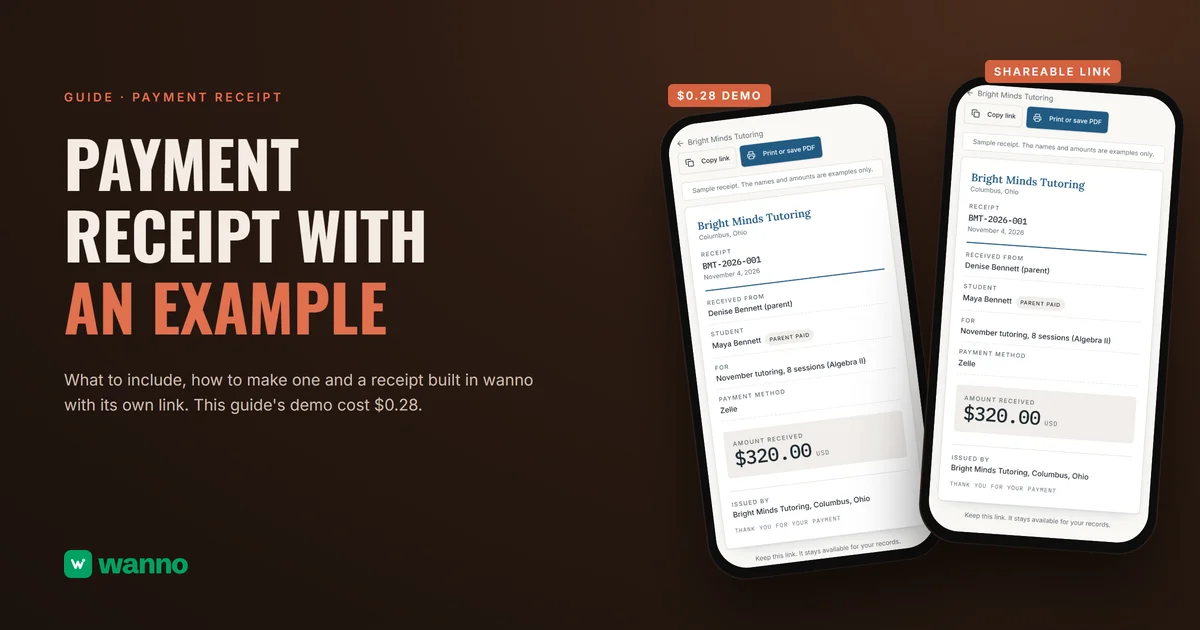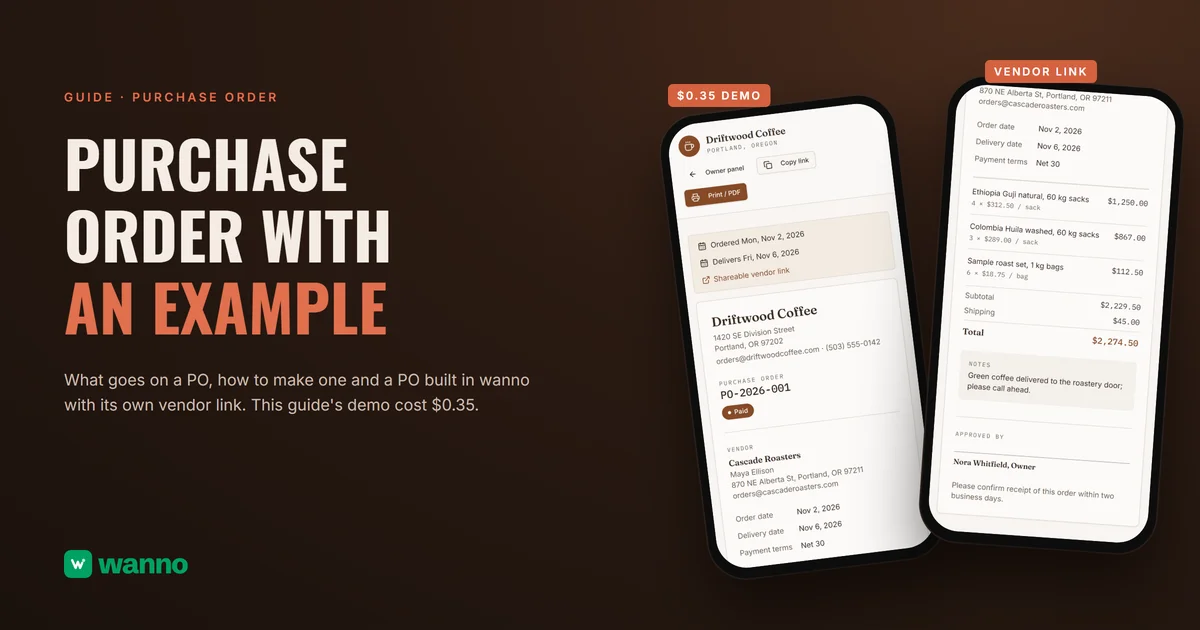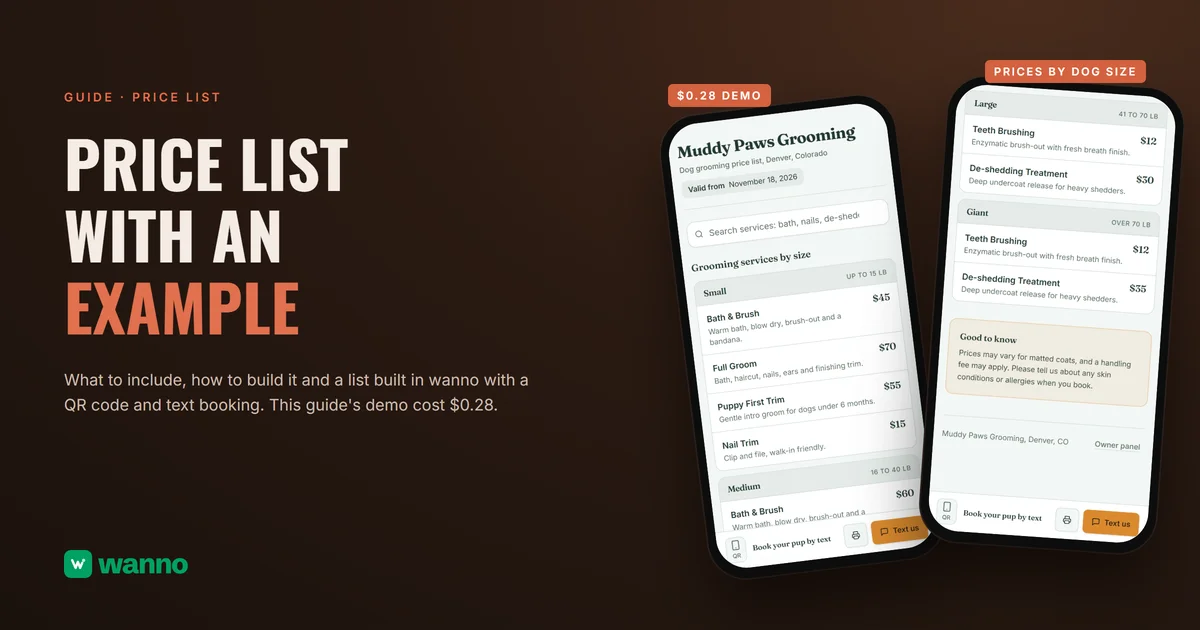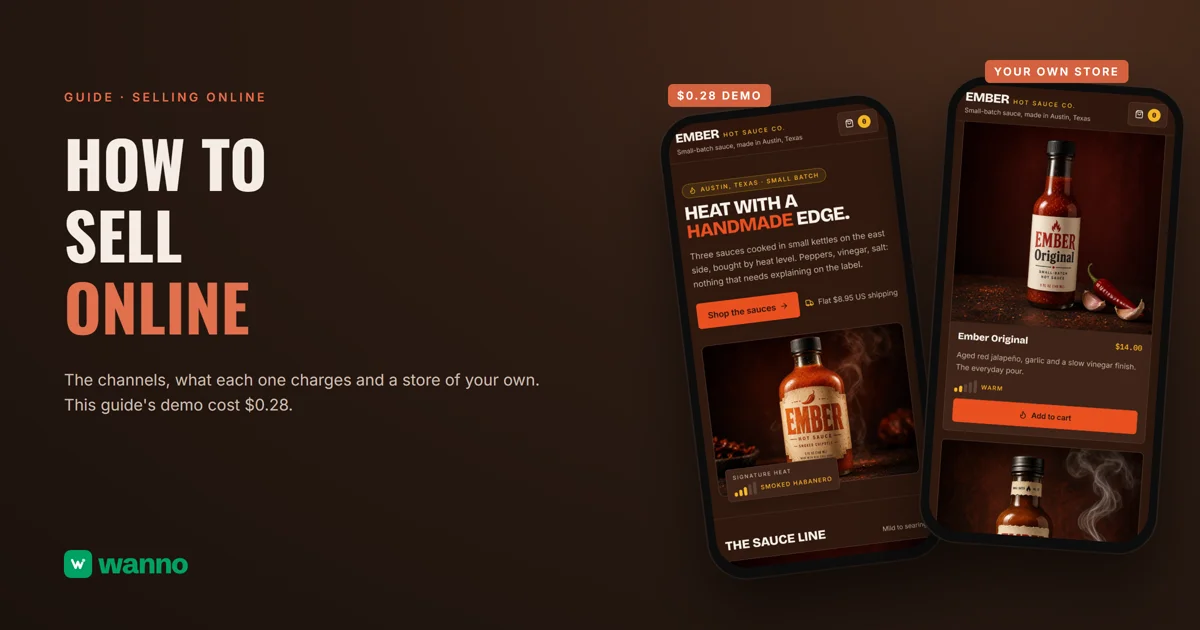
If you are searching for how to sell online and you make the product yourself, such as coffee, hot sauce, honey or jam, the order matters: first pick what to sell and do the math with shipping included, then choose where to sell, and only then build your page. This guide walks through every step with Ember Hot Sauce Co., an example small-batch sauce business in Austin: its store page, with a cart, flat-rate shipping and an order panel, was built in 2 minutes 49 seconds, one adjustment included, and cost $0.28.
In short: How to sell online comes down to eight steps: pick a product, price it with shipping and fees, choose where to sell, prepare photos and a description, decide how you get paid and how you ship, publish with a test order, promote, and look after your buyers and ask them for reviews. You can start with no money down, but shipping and fees are paid anyway. The example store was built by wanno, a platform that builds websites and apps with AI from your phone, and cost $0.28 in credits, paid once.
Updated November 17, 2026.
01. How to sell online: the 8 steps from start to finish
How to sell online comes down to eight steps: pick a product, price it with shipping and fees, choose where to sell, prepare photos and a description, decide how you get paid and how you ship, publish, promote, and take care of your customers. You can start for free, from home and without a store of your own; what changes is the channel.
- Pick a product you already make well and can pack without it breaking.
- Price it with shipping and fees built in.
- Choose where to sell: social media and chat, a marketplace, your own store or local selling.
- Prepare clear photos and a description that answers the buyer's questions.
- Decide how you will get paid and how you will ship.
- Publish and place a complete test order before sharing the link.
- Promote where your people already are: your contacts, your social accounts, your customers.
- Serve your buyers: ship on time and ask for a review.
02. Steps 1 and 2: what to sell and how to price it with shipping
To choose what to sell, start with one product you already make well and that arrives in one piece; to price it, add up its cost, shipping and fees before you publish. Many people start with the website and find out later that each sale leaves less than they thought. The part that surprises most is what it costs to get the product to the customer's door, mostly shipping. So the first step is not technical. It is arithmetic.
Start with one product, or two versions of the same one. If you are unsure what to sell, add one more check: can you make it again at the same quality? There is no list of "most profitable products" that works for everyone: it depends on your cost, your time and your market. What you can do is test with a few real sales before you invest.
Example with round numbers (not market data): a bottle of hot sauce costs you $5 between ingredients, bottle and label, and shipping it costs you $9. If you sell it at $14 and cover shipping yourself, you make $0 on that order before counting your time. If the customer pays shipping, or you sell a gift bundle that spreads the shipping over several bottles, the same shipping stops eating the sale. Decide who pays for shipping before you publish a price. If you also sell on a marketplace, subtract its fee. For a full walkthrough, see how to price a product.
03. Where to sell online: platforms and what each type of channel charges
There are four kinds of places to sell. This table sums up what each one charges and its main limit (US; only figures each company publishes):
| Type of channel | Example | What it charges | The limit |
|---|---|---|---|
| Social media and chat | Instagram, messages | free to post, but there is no cart: each order is settled over messages | you guide every customer by hand |
| Marketplace | Amazon | Individual plan $0.99 per item sold, or Professional $39.99 per month; Grocery and Gourmet referral fee 8% up to $15 and 15% above (source) | you sell inside their store, and the fee comes out of every sale |
| Marketplace for handmade goods | Etsy | $0.20 listing fee per item and a 6.5% transaction fee on the item price plus shipping (source) | there is also a payment processing fee that varies by country |
| Own store by subscription | Shopify | Basic at $39 per month, or $29 per month billed annually; no free plan, only a trial (source) | card rates from 2.9% + 30¢ come on top |
| Own store built with AI | wanno | the store in this guide cost $0.28 in credits, paid once | lives on a wanno.dev subdomain, with a "Built with wanno" badge on the free plan; removing it or using your own domain: Starter, $4.99 per month |
| Local selling | friends, neighbors, pickup | no platform fee: you pay with your time and delivery | reach is limited to your area |
Social media and chat. It is the fastest way: you start today with no site. The limit shows up with volume, because every order is a conversation and tracking who ordered what becomes manual. To set it up well, see how to sell on Instagram and how to sell on WhatsApp.
Your own store. A page with your brand, your cart and your shipping rules. For a full comparison, see how to start an online store. If you sell clothing, there is a separate guide: how to sell clothes online.
With wanno you describe the store in a message and it builds it, with your cart, your prices and your shipping, without choosing templates or installing anything.
04. How to sell online for free: what is really free and what you pay anyway
Can you sell online for free? You can start without investing money, but not everything is free. Here is what is, and what you pay anyway.
Really free:
- Posting on your social accounts and sharing the product with your contacts.
- Local selling to people you already know.
- wanno's free plan: it gives credits every day, with a monthly cap of $1.50.
What you pay anyway:
- Shipping. Someone pays it, you or the customer. It is the hardest cost to avoid.
- Fees. Marketplace fees (Amazon's Individual plan charges $0.99 per item sold; Etsy charges $0.20 per listing plus 6.5% per sale) and card fees come out of every sale.
- Materials, packaging and your time, even if they never show up on an invoice.
- A domain of your own or removing the badge. On wanno's free plan your page lives on a
wanno.devsubdomain and carries the "Built with wanno" badge; removing it or using your own domain is paid.
Put plainly: you can start to sell online with no money down, but not with no costs. The store in this guide cost $0.28 (paid once) and fits inside one day of wanno's free credit. If you want more, the Starter plan is $4.99 per month with $10 in credits included (see plans).
05. Photos and product description: what turns a visit into an order
A buyer cannot touch or smell your product; the photos and the text do that job. These tips are craft judgment, not statistics:
- Natural light and a plain background. A window and a sheet of white poster board are enough. Skip the flash.
- Several shots: the product alone, the product in use, and one that shows its size next to a hand or a cup.
- The same style in every photo, so your store looks orderly.
- A concrete description: what it is, what is in it, size or weight, how to store or use it, and how long delivery takes.
- Name the product with what people search for: "small-batch red jalapeño hot sauce, 5 fl oz" says more than "Ember Original".
- Answer questions before they are asked: payment, shipping areas and returns.
With your photos ready and a couple of lines per product, you have what you need to ask wanno for your store.
06. Build your own store page with AI, from your phone
A store page for a small-batch food product needs little: photos, a price, a cart, shipping, and a way to place the order. The one in this guide was requested like this:
I want a page to sell my small-batch hot sauce online, Ember Hot Sauce Co. from Austin: the sauces with photos, heat level and price in US dollars, a gift box bundle, a cart, flat-rate shipping across the US, order placement and a private panel to see orders, change prices and mark items sold out myself. Everything visible in the app must be in English.
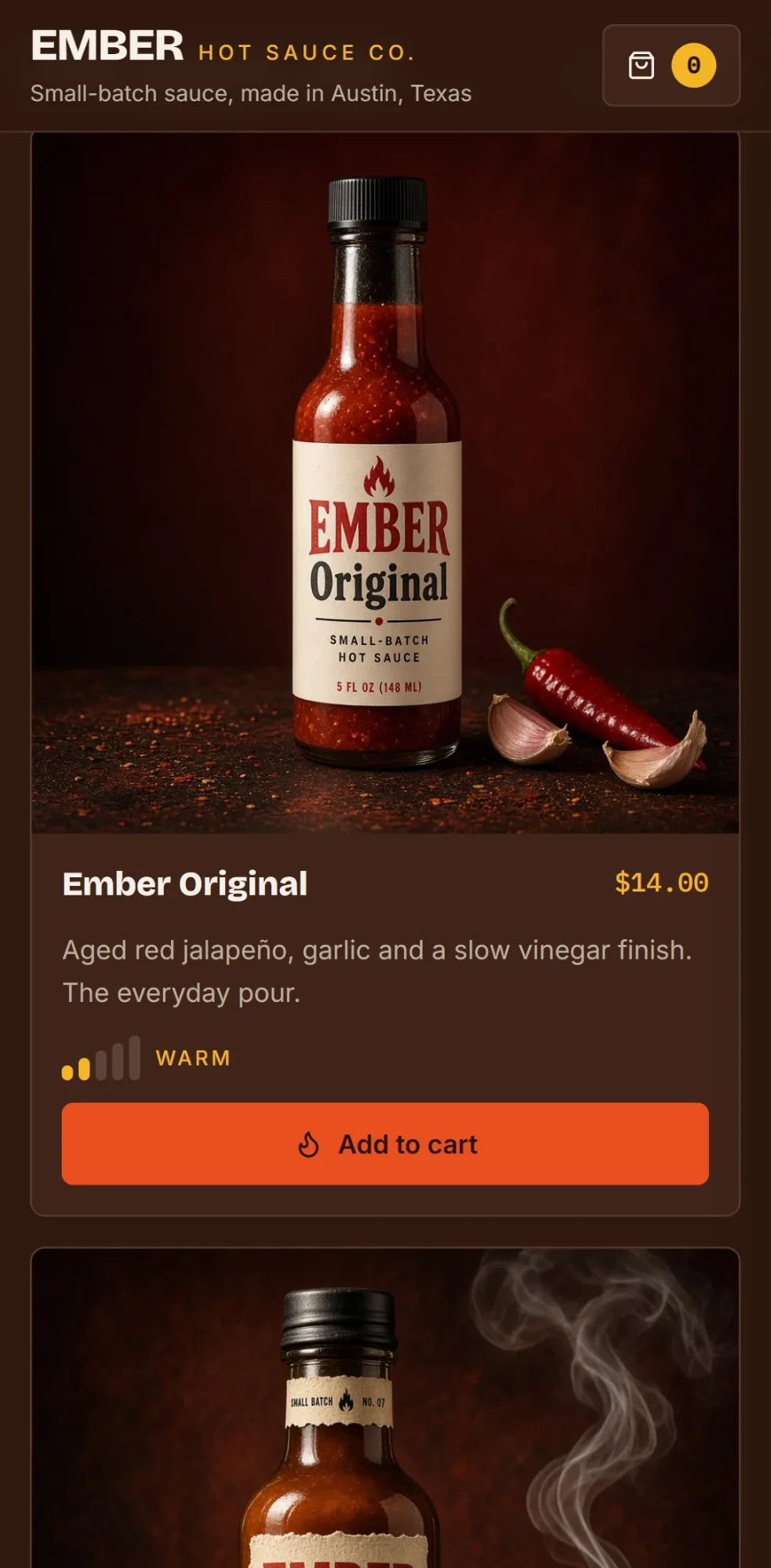
wanno built it in 2 minutes 6 seconds and 32 steps. One adjustment, to replace the long dashes in the store's text, took 43 seconds and 20 more steps: 2 minutes 49 seconds, 52 steps and $0.28 in credits (2.8 credits) in total, which fits inside one day of free credit. The result is three sauces with a photo, a heat level and a price, a gift box called The Pit Box at $44, a cart, and flat-rate shipping of $8.95 that is free from $50.
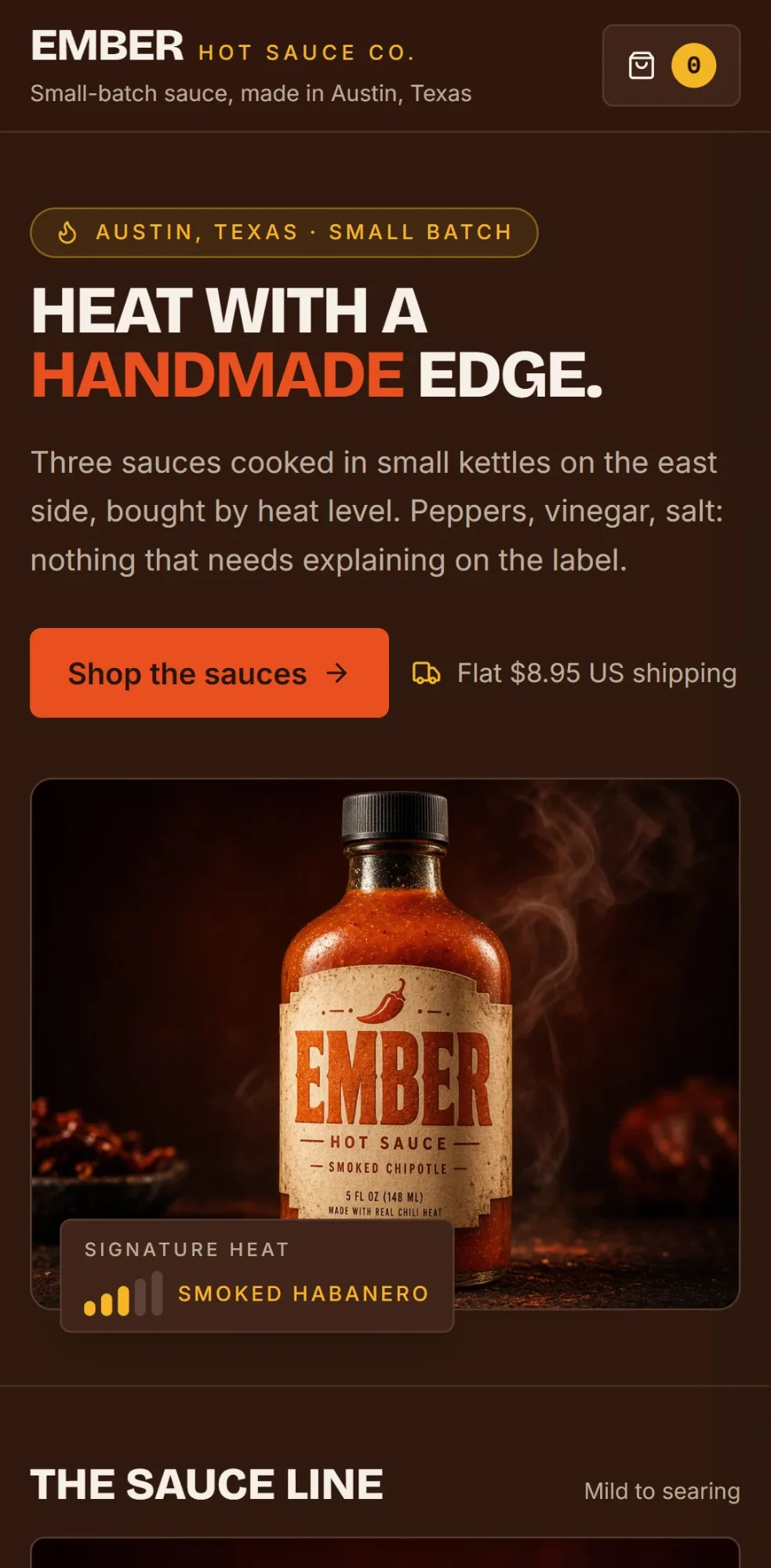
At checkout the order is recorded and the customer gets a confirmation code. The private panel, which you activate by choosing your password, lists orders with their addresses, lets you edit prices and mark a sauce as sold out. This store does not use WhatsApp: orders arrive in the panel. The business, sauces, photos and prices are examples.
07. Payments and shipping: how to get paid and how to work out the cost
Shipping is calculated, not guessed. The example store uses one flat rate, which is simple to explain and easy to put in the math from step 2. Weigh a packed bottle, get quotes from your carrier for two or three destinations, and set a flat rate that covers the average. A free-shipping threshold, like the $50 in the example, can nudge customers to add a bottle, as long as that amount covers your cost.
To get paid there are three usual routes, independent of where you list:
- Bank transfer or a peer-to-peer payment app: no platform fee, but you confirm each payment by hand.
- A payment link: you create it with the payment provider you choose and send it to the customer; the provider charges a fee per transaction.
- Cash on delivery or in person: useful for local selling; you carry the risk that the customer does not take the order.
This store records the order and does not charge cards, so you agree on payment with the customer in a way you already use. Before sharing the link, place a complete test order from your own phone.
08. Promotion, service and reviews: how to find your first customers
A page with no visitors does not sell. Start where people already know you and add one channel at a time, always showing the real product, not only a catalog shot:
- Your contacts first: send the link one by one, with a personal message.
- Your social accounts: link in your bio, a post for each product and a story whenever you restock.
- Local groups and chats: a photo of the real product and the link, shared in neighborhood groups and community chats.
- Reviews: ask a customer who got a good delivery for a photo or a comment, and show it on your page.
- Repeat customers: let people who already bought know when there is a new product.
Reply fast, and tell the buyer when the order ships and when it arrives. Every happy buyer is your best ad. With your store at one link, sharing it from your phone takes a tap: that is how simple it is to promote a page built with wanno.
09. The basic obligations of an online seller, country by country
This is not legal advice. It is the minimum that each country's authorities publish:
- United States (FTC): the Mail, Internet, or Telephone Order Merchandise Rule requires you to ship within the time you state; if you state none, you need a reasonable basis to believe you can ship within 30 days (FTC). For food, rules vary by state: Texas, for example, runs a cottage food program with an annual sales threshold of $150,000 (Texas DSHS).
- Mexico (Profeco): buyers must be able to see your identity and contact details and the total price with shipping, and can withdraw within 5 business days of delivery (Profeco).
- Brazil: article 49 of the Consumer Defense Code gives 7 days to withdraw from a purchase made outside a physical store, such as online (gov.br).
- France: a 14-day withdrawal right for distance purchases (service-public.gouv.fr) and mandatory legal notices on your site (entreprendre.service-public.gouv.fr).
Business licenses and sales tax depend on your state and city, so check with them before you launch. What your page does give you is a clear place for your price and shipping terms.
Your first sale starts with a page
Describe your product in wanno and have your store page in minutes. Before sharing the link, place a complete test order.
Frequently asked questions
Can I sell online for free?
Yes. You can start with no money down on social media and chat, but shipping and fees are paid anyway. With wanno's free plan you get a store page with a cart: it gives credits every day, with a monthly cap of $1.50, carries the "Built with wanno" badge and lives on a wanno.dev subdomain.
How do I start selling online as a beginner? Pick one product, price it with shipping and fees, take clear photos, choose a channel and place a test order. With wanno you describe your store in a message and have your page in minutes.
Where to sell online: which platform is best? It depends on what you sell and how many orders you expect. Social media and chat work to start, marketplaces give visibility for a fee, and a store of your own gives you control. If you want a store with your brand and your shipping rules, wanno builds it from what you describe.
How much does a marketplace charge to sell? It depends on the platform. On Amazon, for example, the Individual plan is $0.99 per item sold and the Grocery and Gourmet referral fee is 8% or 15% depending on the price. Subtract it from your margin the way you do shipping. On your own wanno page you sell without sharing the shelf.
Do I need a permit to sell homemade food? It depends on your state. Texas has a cottage food program, and other states have their own rules. Check with your state health department before selling, then let wanno build the page that sells it.
Read next: How much does a website cost